Link 16 is NATO's primary tactical data link: an encrypted, jam-resistant radio network in the 960–1215 MHz band that lets aircraft, ships, air-defence units and command centres share positions, tracks, orders and voice in near-real time. It is defined by MIL-STD-6016 and STANAG 5516, carries fixed-format J-series messages (TADIL J), and runs on JTIDS and MIDS terminals using time-division multiple access (TDMA).
This guide covers what engineers and program managers actually look up: the frequency plan, the time-slot structure, real data rates and why published figures disagree, Network Participation Groups, terminals and range. For gateway and codec integration depth, see our Link 16 software integration guide.
What is Link 16?
Link 16 is two things at once. It is a message standard — the J-series catalogue of fixed-format binary messages for positions, surveillance tracks, weapons coordination, aircraft control and status; "TADIL J" (Tactical Digital Information Link J) is the older US name for that message set. And it is a radio network — a TDMA waveform that encrypts every transmission, hops across 51 frequencies and gives each participant its own time slots. The US specifies both in MIL-STD-6016, NATO in STANAG 5516; our STANAG 5516 explainer covers the documents.
JTIDS, the first Link 16 terminal programme, dates from the mid-1970s; the US Air Force and Navy fielded systems in the early 1990s. Today Link 16 is operated by the United States, NATO members and partners such as Australia, Japan and South Korea. Typical participants:
- Aircraft — fighters (F-15, F-16, F/A-18, F-35, Eurofighter Typhoon, Rafale, Gripen), maritime patrol aircraft, tankers and AEW&C platforms such as the E-3, E-7 and E-2.
- Ships — carriers, destroyers and frigates across allied navies.
- Air and missile defence — ground-based systems such as Patriot, NASAMS, SAMP/T and THAAD.
- Command and control centres that build and manage the picture.
- Network-enabled weapons — munitions such as JSOW C-1 and SDB II that take in-flight updates.
How the Link 16 data link works
Every unit on the network — a JTIDS/MIDS Unit, or JU — has a terminal that keeps precise network time. Time is divided into 7.8125 ms slots, and the network design, the Network Data Load (NDL) published in the operation's OPTASK LINK, tells each terminal which slots are its transmit slots. Each JU broadcasts in its own slots, and every JU in line of sight hears it directly — there is no master station relaying traffic. Traffic is grouped into Network Participation Groups (NPGs) — logical channels such as PPLI, surveillance, control or voice — so a fighter, an AEW&C aircraft and a ship share one net while each processes only what its role needs.
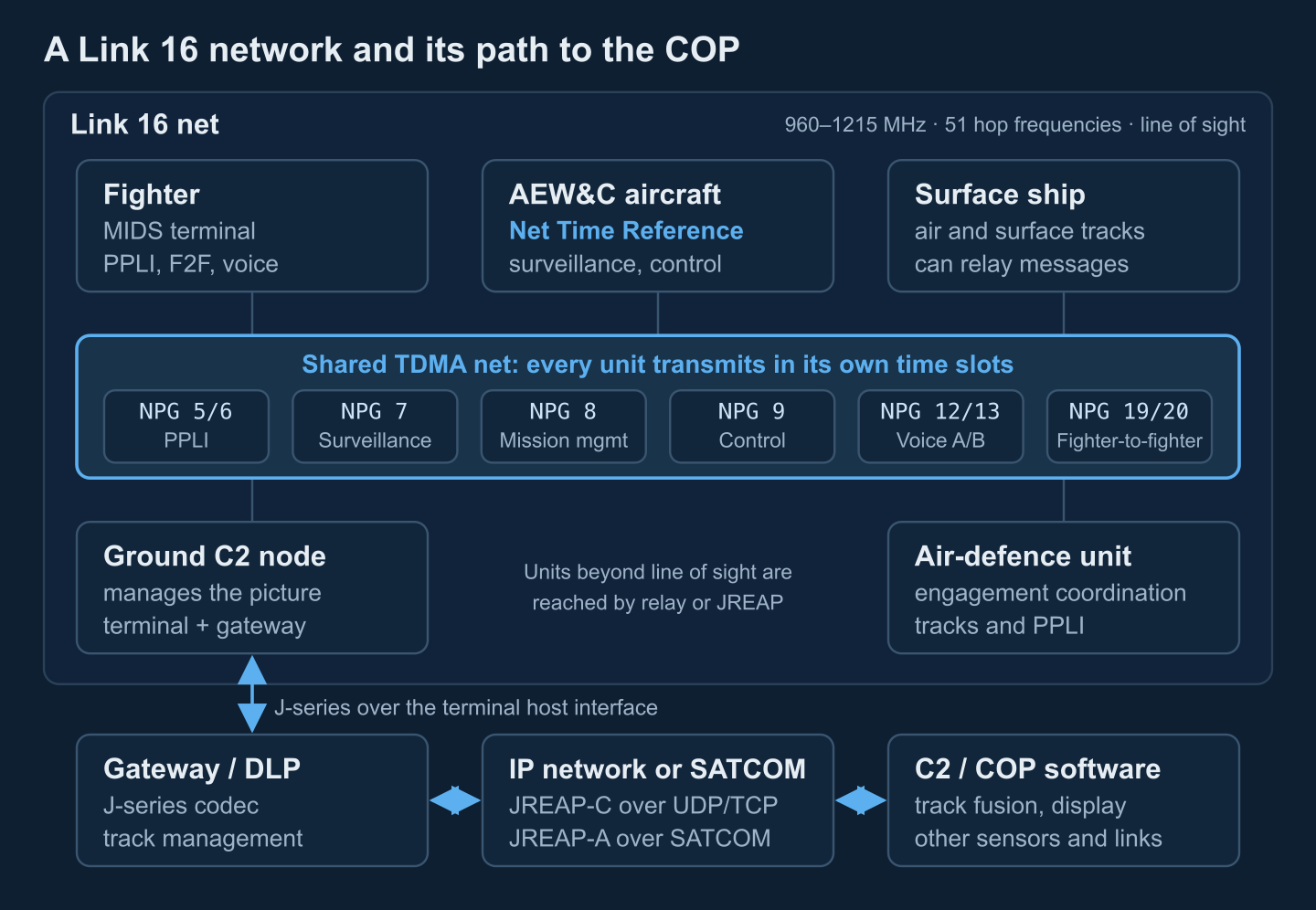
One terminal is the Network Time Reference (NTR): its clock defines network time, is never corrected by the network, and there is exactly one per net. A joining terminal reaches coarse synchronisation by receiving an Initial Entry message (NPG 1), then fine synchronisation by exchanging Round-Trip Timing messages (RTT, NPGs 2 and 3). Units beyond the radio horizon are reached by relay — re-transmission in separately assigned slots — or by carrying J-series messages over other media with JREAP, covered below.
Link 16 frequency range
Link 16 operates in the 960–1215 MHz band — the UHF "Lx" band, which the ITU allocates to aeronautical radionavigation. Terminals hop across 51 centre frequencies from 969 to 1206 MHz, spaced 3 MHz apart. The hop set is split into three sub-bands so that no Link 16 carrier lands near 1030 MHz or 1090 MHz, the IFF/SSR interrogation and reply frequencies:
| Part of the band | Centre frequencies | Hop channels |
|---|---|---|
| Lower sub-band | 969–1008 MHz | 14 |
| Gap around 1030 MHz (IFF interrogation) | none between 1008 and 1053 MHz | — |
| Middle sub-band | 1053–1065 MHz | 5 |
| Gap around 1090 MHz (IFF reply) | none between 1065 and 1113 MHz | — |
| Upper sub-band | 1113–1206 MHz | 32 |
| Total | 969–1206 MHz (237 MHz spread) | 51 |
The band is shared with DME, TACAN, IFF/SSR, ADS-B, collision-avoidance systems and, at the top, GNSS signals such as GPS L5 — and Link 16 is a secondary user there, operating on a non-interference basis under national frequency clearance agreements. That is why it carries transmission limits most military radios do not (see limitations).
Frequency hopping and pulse structure
Each pulse carries a 5-bit symbol encoded as one of 32 cyclic shifts of a 32-chip sequence (cyclic code shift keying, CCSK), scrambled with a pseudo-random chip pattern and MSK-modulated at 5 Mchip/s. A pulse lasts 6.4 µs followed by 6.6 µs of dead time — one pulse every 13 µs — and the carrier hops to a new frequency on every pulse, 76,923 times a second, in an order set by the transmission-security key and the net number. Message data is protected with Reed-Solomon RS(31,15) coding, the header with RS(16,7), and symbols are interleaved. In double-pulse formats every symbol is sent twice on two different frequencies (26 µs per symbol), trading capacity for jam resistance.
Encryption and anti-jam
Two crypto variables protect the link. Message security (MSEC) encrypts the content; transmission security (TSEC) hides the waveform — with the net number it keys the hopping pattern, the chip-scrambling noise and the random jitter delay at the start of each slot, so a jammer cannot predict where or when the next pulse will be. Spreading, interleaved coding and double-pulse diversity add margin. The legacy algorithms are now being replaced through crypto modernization (see terminals below).
Link 16 TDMA: time slots, frames and epochs
Link 16 timing nests three units:
- Time slot — 7.8125 ms, i.e. 1/128 s: one transmit opportunity, 128 per second.
- Frame — 12 seconds, 1,536 time slots.
- Epoch — 12.8 minutes, 64 frames, 98,304 time slots; the schedule then repeats (112.5 epochs a day).
The slots are interleaved into three sets — A-0, B-0, C-0, A-1, B-1, C-1 and so on — so each set holds 512 slots per frame and 32,768 per epoch. An assignment is written as set, starting index and recurrence rate number R, meaning 2^R slots per epoch (R = 0–15). A block at rate 10, for example, is 1,024 slots per epoch: one slot every 0.75 s. Planners do this arithmetic NPG by NPG — our Link 16 network design guide walks through it.
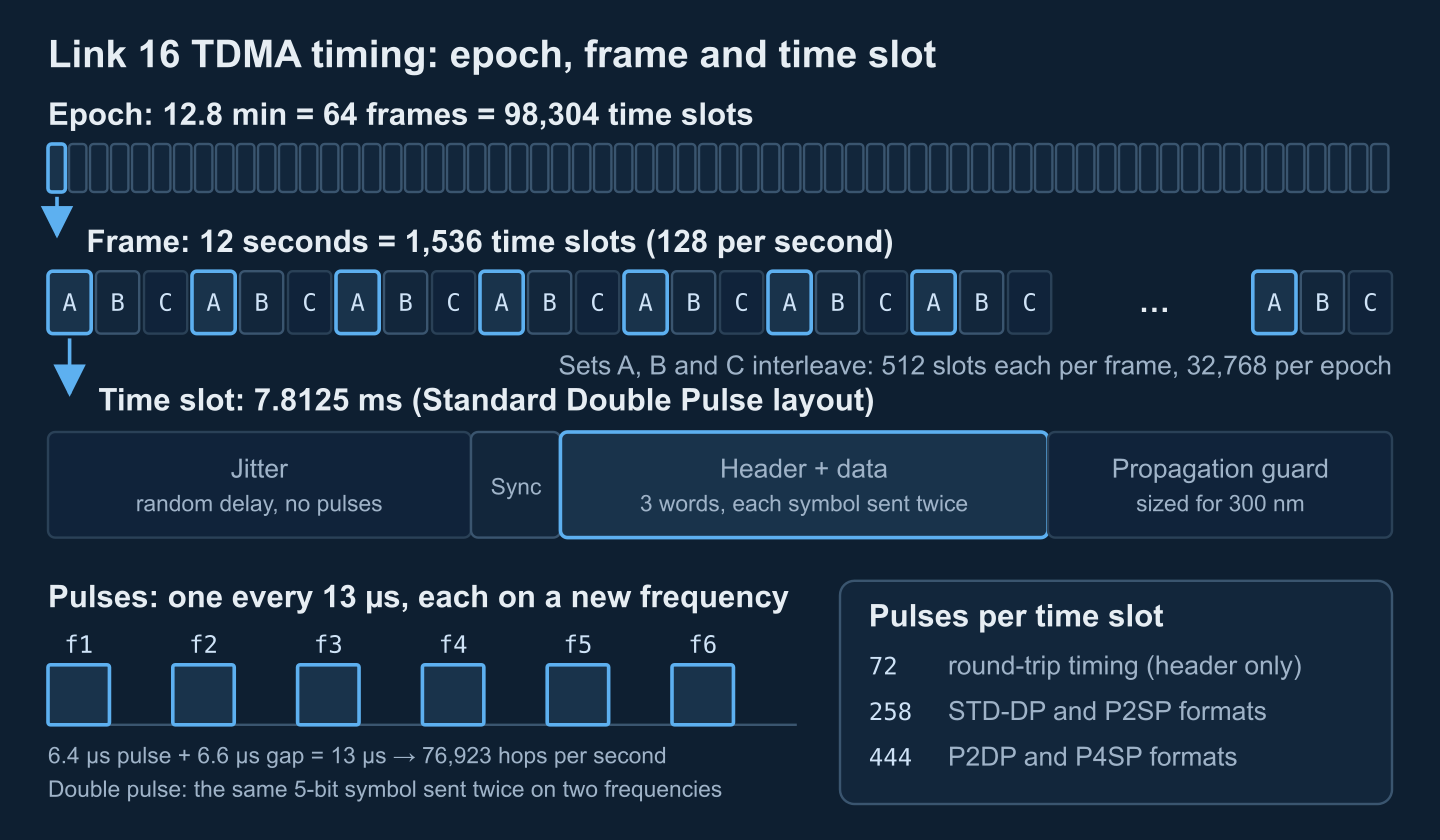
Inside a slot, the standard format runs: pseudo-random jitter delay, synchronisation and time-refinement pulses, message header and data, then a propagation guard so the signal reaches distant receivers before the next slot. A slot carries 72 pulses (header-only RTT), 258 (Standard Double Pulse, Packed-2 Single Pulse) or 444 (Packed-2 Double Pulse, Packed-4 Single Pulse); the denser formats shrink the jitter to make room, giving up anti-jam margin.
How much bandwidth does Link 16 have?
Search for Link 16's data rate and you will find 26.88 kbps, 115.2 kbps, 238 kbps and "over 1 Mbps" — sometimes on the same page. Most are correct; they count different things. All follow from three facts: a net has 128 slots per second; a packing format puts 3, 6 or 12 words in a slot; and each J-series word is 75 bits (70 data + 5 parity), which Reed-Solomon coding expands to 155 bits on air.
| Packing format | Words per slot | Pulses per slot | J-series data (70-bit words) | Incl. parity (75-bit words) | Free text, no RS coding |
|---|---|---|---|---|---|
| Standard Double Pulse (STD-DP) | 3 | 258 | 26.88 kbps | 28.8 kbps | 59.52 kbps |
| Packed-2 Single Pulse (P2SP) | 6 | 258 | 53.76 kbps | 57.6 kbps | 119.04 kbps |
| Packed-2 Double Pulse (P2DP) | 6 | 444 | 53.76 kbps | 57.6 kbps | 119.04 kbps |
| Packed-4 Single Pulse (P4SP) | 12 | 444 | 107.52 kbps | 115.2 kbps | 238.08 kbps |
- J-series data is what an application can use for fixed-format messages: 70 bits × words per slot × 128 slots per second.
- Including parity counts the full 75-bit words; this is the "coded" or "protected" rate that terminal data sheets quote, e.g. 115 kbps for Packed-4.
- Free text without Reed-Solomon coding, used mainly for digital voice, fills all 155 bits of every block — 1,860 bits per Packed-4 slot, hence the 238 kbps on some data sheets — at the cost of error correction.
- Enhanced Throughput (ET) on MIDS-JTRS replaces the classic coding scheme and raises the protected rate from 115 kbps to over 1 Mbps (vendor data quotes up to 1,102 kbps), at the cost of robustness and range.
Two caveats matter more than the headline number. These are totals for one net, shared by every participant: a unit transmits only in the slots the network design gives it, against the classic ceiling of 1,536 J-words per second (12 words × 128 slots). And operational nets rarely run flat-out in Packed-4, because dense packing costs anti-jam margin and peacetime frequency clearances limit pulse density; capacity grows by stacking nets on different net numbers, not by speeding one net up. In RF terms there is no channel width to quote — each net's pulses spread across the whole 969–1206 MHz hop set. Voice uses two channels at 2.4 kbps (LPC-10) or 16 kbps (CVSD).
Network Participation Groups and network roles
An NPG is an agreed list of messages, by label and sub-label, serving one function; its messages go out in the slots assigned to that NPG, and units subscribe to the NPGs their role needs. The numbering is standard; the slot count per NPG is decided for each operation. Commonly used NPGs:
| NPG | Name | What it carries |
|---|---|---|
| 1 | Initial Entry | Entry messages that let terminals synchronise to the net |
| 2 / 3 | RTT-A / RTT-B | Round-trip timing for fine synchronisation (addressed / broadcast) |
| 4 | Network Management | Net management and control |
| 5 / 6 | PPLI and Status | Each unit's own Precise Participant Location and Identification (J2 series) |
| 7 | Surveillance | Air, surface, subsurface, land and space tracks (J3 series) |
| 8 | Mission Management / Weapons Coordination | Mission management and weapons coordination messages |
| 9 | Control | Control of aircraft by C2 units (J12 series) |
| 12 / 13 | Voice A / Voice B | Two secure digital voice channels |
| 18 | Network Enabled Weapons | Messages to and from weapons in flight |
| 19 / 20 | Fighter-to-Fighter A / B | Data exchanged within fighter flights |
Roles sit beside NPGs. Besides the NTR, a network names Initial Entry JUs for late joiners, a Net Position Reference and Primary and Secondary Navigation Controllers for relative navigation, and relay units; it also distinguishes C2 units, which manage the picture (track numbers, reporting responsibility, identification), from non-C2 units such as fighters, which mostly consume it. All of it is fixed in the OPTASK LINK and NDL before the first terminal enters the net.
Link 16 terminals: JTIDS, MIDS-LVT and MIDS-JTRS
A J-series message becomes Link 16 only when a terminal schedules, encodes, encrypts and transmits it. Three families matter:
| Terminal | What it is | Notes for integrators |
|---|---|---|
| JTIDS | First-generation US Link 16 terminals | Largely superseded by MIDS on current platforms |
| MIDS-LVT | Low Volume Terminal developed by the US, France, Germany, Italy and Spain. Variants include LVT(1) with voice and TACAN (e.g. F/A-18, Eurofighter, Rafale), LVT(2) for US Army ground units and LVT(3), the Fighter Data Link terminal for the F-15 | Host interfaces include MIL-STD-1553, Ethernet, X.25 and STANAG 3910 (LVT(1)); 1, 25 or 200 W output |
| MIDS-JTRS | Software-defined successor in the MIDS-LVT form factor: a Link 16 channel plus TACAN and three programmable channels | Adds Concurrent Multi-Netting (CMN-4), Concurrent Contention Receive, Enhanced Throughput, frequency remapping and crypto modernization |
Two upgrades matter when you read a platform's equipment list. Crypto modernization replaces the legacy Link 16 algorithms — programmable crypto on MIDS-JTRS, a Block Upgrade 2 (BU2) retrofit on MIDS-LVT. Concurrent Multi-Netting-4 (CMN-4) lets a MIDS-JTRS terminal receive four messages on four net numbers in the same time slot, and Concurrent Contention Receive decodes several contention transmissions in one slot, so one ship- or ground-mounted terminal monitors more of a multi-net architecture. Frequency remapping enables "banded" operation clear of other users of the band, and smaller form-factor Link 16 radios exist for platforms that cannot host a MIDS box. Our MIDS terminal guide covers the hardware decision in depth.
Link 16 range, relay and JREAP
Link 16 is line-of-sight radio. The propagation guard in each slot is sized for 300 nautical miles, or 500 nm in extended-range mode — available only with the Standard and Packed-2 Single Pulse formats. In practice the horizon decides first: aircraft at altitude can use the full range, ships and ground units see far less. Three mechanisms take Link 16 further:
- Relay — an airborne or surface terminal re-transmits messages in separately assigned slots. It stays on the native waveform but consumes extra slots for every relayed message.
- JREAP (MIL-STD-3011 / STANAG 5518) wraps J-series messages for other media. JREAP-A uses announced token passing over half-duplex links such as UHF DAMA SATCOM, down to 2,400 bps; JREAP-B is point-to-point serial; JREAP-C runs over IP using UDP or TCP and is the usual choice for C2 centres and gateways.
- SIMPLE (STANAG 5602) links TDL test rigs and laboratories over IP or serial lines, repackaging host-interface traffic so remote equipment sees it as if it came from a terminal.
Many C2 applications never touch the RF side at all: they receive Link 16 as JREAP-C traffic from a gateway attached to a terminal elsewhere, and distributed training does the same with SISO-STD-002 over DIS and HLA.
What a software team builds around Link 16
J-series messages are built from 75-bit words: an initial word — whose first bits identify the message — followed by extension and optional continuation words; label and sub-label give the familiar "J3.2" notation:
J-series initial word, 75 bits (bit 0 = least significant)
bits  0-1   word format      00 initial, 10 extension, 01 continuation
bits  2-6   label            J0 ... J31
bits  7-9   sub-label        .0 ... .7     (J3.2 = label 3, sub-label 2)
bits 10-12  message length   words in the message
bits 13-69  message fields   defined per message in MIL-STD-6016
bits 70-74  parity
Labels group messages by function: J0–J1 network management, J2 PPLI, J3 surveillance (J3.2 Air Track, J3.3 Surface Track), J7–J8 information management, J9–J11 weapons coordination, J12 control (J12.0 Mission Assignment), J13 platform status, J14–J17 EW, threat warning, imagery and weather, J28–J30 national use, J31 miscellaneous. Our complete J-series message list catalogues every label, and the J-series field guide covers codec pitfalls.
A software team rarely builds the radio. It builds everything between the terminal and the operator:
- Host interface adapter. Loads initialization data and exchanges J-words with the terminal over MIL-STD-1553 or Ethernet for the assigned NPGs and slots.
- J-series codec. Bit-exact encode/decode per MIL-STD-6016 — "no statement" values, spare bits, continuation words — tested against reference vectors. The standard is distribution-restricted, so access runs through a government sponsor.
- Data link processing. Track numbers, reporting responsibility, correlation, identification, and the issuance and receipt rules the standard imposes.
- Gateway to the C2 system. Translating J-series tracks into the model of a common operational picture and forwarding to JREAP-C, other links or CoT — the job of a tactical data link gateway.
- Test tooling. SIMPLE and SISO-STD-002 stimulators, recorders and analysers, so most testing happens before anyone books a live net.
Building on Link 16? We build J-series codecs, MIDS host-interface adapters, multi-link gateways (Link 16, JREAP-C, Link 22, CoT) and Link 16 track ingestion into C2 and COP software, with test harnesses on SIMPLE and SISO-STD-002. Tell us about your integration and we will come back with an architecture and a test plan.
Link 16 limitations, and what will replace it
- Line of sight. Beyond about 300 nm (500 nm extended) and the radio horizon, you need relay slots or JREAP.
- Capacity. 128 slots per second per net, at most ~107.5 kbps of J-series data in classic packing — shared by every participant. Relay consumes slots, dense packing costs anti-jam margin, and imagery or video barely fits.
- Spectrum rules. National frequency clearance agreements cap transmit power and pulse density as a two-number Time Slot Duty Factor (TSDF). A TSDF of 100/50 limits all terminals within line of sight to 396,288 pulses per 12-second frame (1,536 slots × 258 pulses), a single terminal to half that — and, since Packed-4 slots carry 444 pulses, covers at most ~58% of slots in that format. Terminals implement an Interference Protection Feature that enforces the peacetime limits.
- Cost and access. Terminals are expensive and export-controlled, crypto needs national release, the message standard is restricted, and every net needs planning, keys and initialization data before it carries traffic.
So what will replace Link 16? Not one thing, and not soon: the installed base is modernised in place (crypto modernization, frequency remapping, CMN-4, Enhanced Throughput) while other links take specific jobs — Link 22 for beyond-line-of-sight maritime work, IP-based tactical networks for traffic that does not fit in 7.8125 ms slots. We cover the roadmap in what will replace Link 16 and compare the links in Link 11 vs Link 16 vs Link 22.
Integrating Link 16 into your C2 or COP?
We build J-series codecs, MIDS host-interface adapters, JREAP-C and SIMPLE gateways, and Link 16 track fusion for C2 and COP software. Tell us what your platform needs to send and receive over the link.
Prepared by Corvus Intelligence engineers who build tactical data link gateways, J-series codecs and C2 software, and checked against public sources including SISO-STD-002-2021, vendor terminal data and Naval Postgraduate School waveform studies. About Corvus Intelligence →