Link 16 J-series messages are the fixed-format binary messages (TADIL J) defined by MIL-STD-6016 and NATO STANAG 5516. Each one is named by a label from J0 to J31 and a sublabel from 0 to 7: J2.2 is Air PPLI, J3.2 is Air Track, J12.0 is Mission Assignment. The tables below list every publicly documented J-message with its name and purpose, grouped by function.
The list is built only from public sources and cross-checked between them: the US multi-service quick reference FM 6-24.8 (2000), the SISO-STD-002 Link 16 simulation standard and vendor training and product material. It is designed to be printed: use your browser’s print dialog or Save as PDF and the blog’s print stylesheet drops the navigation. For how the words are decoded and where codecs go wrong, read the companion Link 16 J-series field guide; for the waveform and terminals underneath, see what Link 16 is.
How to read a Link 16 J-series message label
A label such as J3.2 holds two numbers. The first is the 5-bit label (0–31), which names the message family — J3 is surveillance. The second is the 3-bit sublabel (0–7), which picks one message in that family: J3.2 is the air track, J3.3 the surface track. Both sit at the start of the message’s initial word, so a decoder knows which message it holds after the first ten bits.
Three more notations show up in specifications and logs:
- Word suffixes. An I, E or C after the label names one word of a message:
J10.2Iis the initial word of Engagement Status andJ10.2C2its continuation word 2. - Parenthesized numbers.
J28.2(0)is a specific message inside the J28.2 national label — here the Text Message used for free text. - Gaps. Not every number is used. J4 and J18–J27 do not appear in the public catalogs, and J5 contributes a single message, J5.4.
The entry marked † appears in only one public source; confirm it against the standard revision your program uses.
J0–J8: network management, PPLI, surveillance and information management
These families keep the network running and build the shared picture: J0 and J1 manage the network, J2 lets every terminal report itself, J3 carries what sensors see, and J7 turns many independent reports into one consistent picture.
Network management (J0, J1)
| Label | Message | Purpose |
|---|---|---|
| J0.0 | Initial Entry | Carries network time so terminals can synchronize and enter the net |
| J0.1 | Test | Tests link operation between terminals |
| J0.2 | Network Time Update | Updates network time |
| J0.3 | Time Slot Assignment | Assigns time slots to a terminal over the air |
| J0.4 | Radio Relay Control | Controls a terminal’s relay function |
| J0.5 | Repromulgation Relay | Directs relay (repromulgation) of messages |
| J0.6 | Communication Control | Directs a terminal’s communication settings |
| J0.7 | Time Slot Reallocation | Announces reallocation of time slots between units |
| J1.0 | Connectivity Interrogation | Asks a unit to report its connectivity |
| J1.1 | Connectivity Status | Reports a unit’s connectivity |
| J1.2 | Route Establishment | Sets up a message route between units |
| J1.3 | Acknowledgment | Acknowledges a received message |
| J1.4 | Communication Status | Reports a unit’s communication status |
| J1.5 | Net Control Initialization | Initializes net control |
| J1.6 | Needline Participation Group Assignment | Assigns units to needline participation groups |
Precise participant location and identification (J2)
| Label | Message | Purpose |
|---|---|---|
| J2.0 | Indirect Interface Unit PPLI | PPLI of a unit forwarded onto Link 16 from another link |
| J2.2 | Air PPLI | An aircraft’s own position and identification |
| J2.3 | Surface PPLI | Same, for a surface ship |
| J2.4 | Subsurface PPLI | Same, for a submarine |
| J2.5 | Land Point PPLI | Same, for a stationary land unit |
| J2.6 | Land Track PPLI | Same, for a mobile land unit |
Surveillance (J3)
| Label | Message | Purpose |
|---|---|---|
| J3.0 | Reference Point | Geographic reference points, lines and areas |
| J3.1 | Emergency Point | Marks the position of an emergency |
| J3.2 | Air Track | Sensor-derived air track |
| J3.3 | Surface Track | Maritime surface track |
| J3.4 | Subsurface Track | Subsurface track |
| J3.5 | Land Point or Track | Fixed land objects (SAM sites, HQs) or moving vehicles |
| J3.6 | Space Track | Objects in space, such as ballistic missiles |
| J3.7 | Electronic Warfare Product Information | Non-parametric EW product on emitters |
Anti-submarine warfare, intelligence and information management (J5–J8)
| Label | Message | Purpose |
|---|---|---|
| J5.4 | Acoustic Bearing and Range | Sonar bearing and range for anti-submarine warfare |
| J6.0 | Intelligence Information | Intelligence data on tracks and units |
| J7.0 | Track Management | Management actions on reported tracks |
| J7.1 | Data Update Request | Requests fresh data on a track |
| J7.2 | Correlation | Declares that two track numbers are one object |
| J7.3 | Pointer | Points other units at a position or track |
| J7.4 | Track Identifier | Identification data for a track |
| J7.5 | IFF/SIF Management | IFF/SIF code data, including difference reports |
| J7.6 | Filter Management | Manages data filters between units |
| J7.7 | Association | Associates related tracks or units |
| J8.0 | Unit Designator | A unit’s designator information |
| J8.1 | Mission Correlator Change | Changes the mission correlator of a unit |
J9–J17: weapons coordination, control, status and EW
These families make Link 16 a command channel rather than a picture feed. J11 was added for network-enabled weapons through a change to MIL-STD-6016C, so it is missing from the 2000 catalog; J16.0 and J17.0 appear in later vendor catalogs and gateway specifications.
Weapons coordination and management (J9–J11)
| Label | Message | Purpose |
|---|---|---|
| J9.0 | Command | Directs weapon employment and other C2 actions |
| J9.1 † | Engagement Coordination | Coordinates engagements between units |
| J10.2 | Engagement Status | Reports the status of an engagement |
| J10.3 | Handover | Passes control of an aircraft or engagement to another unit |
| J10.5 | Controlling Unit Report | Reports controlling-unit data for assets under control |
| J10.6 | Pairing | Pairs weapons or fighters with targets (commits) |
| J11.0 | Weapon Response/Status | From the weapon: in-flight track, ack/nack, hit indication |
| J11.1 | Weapon Directive | To the weapon: in-flight target updates and other directives |
| J11.2 | Weapon Coordination | Between controllers and third-party targeting sources |
Control (J12)
| Label | Message | Purpose |
|---|---|---|
| J12.0 | Mission Assignment | Assigns a mission or target to a controlled aircraft |
| J12.1 | Vector | Steering vector for a controlled aircraft |
| J12.2 | Precision Aircraft Direction | Precise direction of a controlled aircraft |
| J12.3 | Flight Path | Flight path for a controlled aircraft |
| J12.4 | Controlling Unit Change | Orders a change of controlling unit |
| J12.5 | Target/Track Correlation | Correlates a fighter’s target with a network track |
| J12.6 | Target Sorting | Sorts targets among fighters; also used for sensor points of interest |
| J12.7 | Target Bearing | Reports a bearing to a target |
Status, electronic warfare, threat warning, imagery and weather (J13–J17)
| Label | Message | Purpose |
|---|---|---|
| J13.0 | Airfield Status Message | Status of an airfield |
| J13.2 | Air Platform and System Status | Aircraft status: fuel, weapons, equipment |
| J13.3 | Surface Platform and System Status | Same, for ships |
| J13.4 | Subsurface Platform and System Status | Same, for submarines |
| J13.5 | Land Platform and System Status | Same, for land units |
| J14.0 | Parametric Information | EW parametric data on emitters |
| J14.2 | Electronic Warfare Control/Coordination | EW orders and coordination |
| J15.0 | Threat Warning | Warns units of a threat |
| J16.0 | Imagery | Still-image transfer |
| J17.0 | Weather Over Target | Weather conditions over a target area |
J28–J31: national use, free text and housekeeping
J28 sublabels are allocated to nations and services, which define their own content; the one most integrators meet is J28.2(0), the free-text message. J31 holds cryptographic housekeeping and the slot filler.
| Label | Message | Purpose |
|---|---|---|
| J28.0 | U.S. National 1 (Army) | Reserved for US Army-defined messages |
| J28.1 | U.S. National 2 (Navy) | Reserved for US Navy-defined messages |
| J28.2 | U.S. National 3 (Air Force) | Reserved for US Air Force-defined messages |
| J28.2(0) | Text Message | Fixed-format free text (remarks, short orders) |
| J28.3 | U.S. National 4 (Marine Corps) | Reserved for USMC-defined messages |
| J28.4 | French National 1 | Reserved for French national use |
| J28.5 | French National 2 | Reserved for French national use |
| J28.6 | U.S. National 5 (NSA) | Reserved for NSA-defined messages |
| J28.7 | UK National | Reserved for UK national use |
| J29 | National Use (reserved) | Reserved for national use |
| J30 | National Use (reserved) | Reserved for national use |
| J31.0 | Over-the-Air Rekeying Management | Manages over-the-air rekeying (OTAR) |
| J31.1 | Over-the-Air Rekeying | Carries OTAR key material |
| J31.7 | No Statement | One-word filler that pads a slot to 3, 6 or 12 words |
The J-messages a typical air picture depends on
A consumer that only needs the air picture — a C2 display, a fusion engine, a gateway feeding a COP — gets most of its value from a small subset. These are the messages to implement first:
| Label | What it carries | Why an air-picture consumer needs it |
|---|---|---|
| J2.2 / J2.0 | Position and identification of each aircraft on the net; forwarded units | The authoritative friendly (blue) air picture |
| J3.2 | Track number, position, course and speed, identity, track quality (0–15) | Everything sensors see that is not reporting itself |
| J3.0 | Reference points, lines and areas | Control points and areas drawn on the COP |
| J7.0 / J7.2 / J7.3 | Track management, correlation, pointers | Keeps the picture consistent and free of duplicates |
| J13.2 | Fuel, weapons and equipment status | What each aircraft can still do |
| J12.0 / J12.1 / J12.6 | Mission assignment, vectors, target sorting | Needed by control and fighter displays |
| J10.2 | Engagement status | Needed by air-defense displays |
| J28.2(0) | Free text | Operator remarks that fit no structured message |
Keep J2 and J3 apart. J2.2 is an aircraft on the net reporting itself; J3.2 is a track that a surveillance unit reports about something it observes, which may be hostile, unknown or a friendly without a terminal. Track identity in J3 combines environment, identity, platform, activity, specific type and nationality, and track quality runs from 0 to 15.
J-series message structure: words, bits and time slots
Every J-message is built from 75-bit words: 70 data bits plus 5 parity bits. The initial word opens the message with a 2-bit word format code, the 5-bit label, the 3-bit sublabel, a 3-bit message length indicator (MLI) and 57 bits of fields. Extension words add 68 bits of fields; continuation words carry their own 5-bit continuation label and 63 bits of fields. Each slot opens with a 35-bit header word naming the slot type and the sender’s source track number.
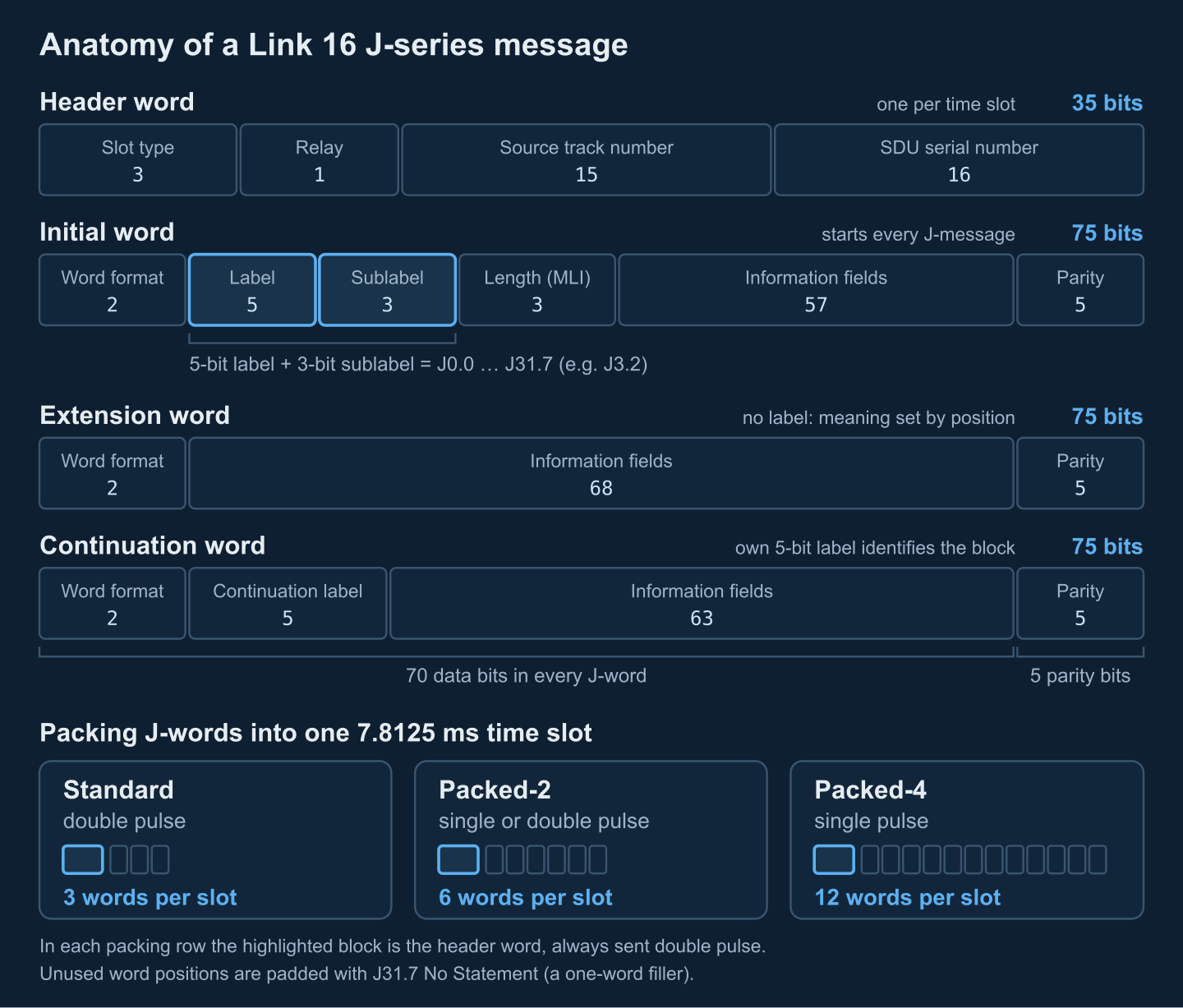
| Word | Fields (bits) | Role |
|---|---|---|
| Header (one per slot) | slot type 3 · relay 1 · source track number 15 · SDU serial number 16 = 35 | Identifies the sender and how the slot is used |
| Initial (I) | word format 2 · label 5 · sublabel 3 · length indicator 3 · data 57 · parity 5 | Starts every J-message |
| Extension (E) | word format 2 · data 68 · parity 5 | More fields; no label, so position defines meaning |
| Continuation (C) | word format 2 · continuation label 5 · data 63 · parity 5 | A labelled block of further fields |
The packing chosen for a slot decides how many words it carries: 3 in standard double pulse, 6 in packed-2 single or double pulse, 12 in packed-4 single pulse. Packed and single-pulse formats trade anti-jam margin for capacity, and the header always goes double pulse. On the air, each 75-bit word is fifteen 5-bit symbols; a three-word data block is protected as three (31,15) Reed–Solomon codewords — 93 symbols, one per pulse — while the 35-bit header is coded as a (16,7) codeword. With 128 slots per second, the ceiling is 1,536 J-words per second; terminals pad unused positions with J31.7.
Building a J-series decoder or gateway? We build J-series encoders and decoders, label-level message filters and Link 16 ↔ Link 22 / CoT translators, with round-trip test vectors for every message in scope. Tell us which J-labels and links you need →
Link 16 message types beyond the J-series
“Link 16 messages” covers more than the J-catalog. A terminal handles six kinds of traffic:
| Type | What it is |
|---|---|
| Fixed-format (J-series) | 75-bit words with label and sublabel: the catalog on this page |
| Free text | Bit-oriented messages that use every bit for data, such as digitized voice or teletype; not the same as J28.2(0) |
| Voice | Two secure digitized voice channels (voice groups A and B) at 2.4 or 16 kbit/s |
| Variable Message Format (VMF) | VMF messages carried in Link 16 words: 2-bit word format, 68 data bits, 5 parity bits |
| Round-trip timing (RTT) | RTT-A (addressed) and RTT-B (broadcast) interrogations plus RTT reply, 35-bit words used for fine synchronization |
| Link 16 Enhanced Throughput (LET) | Higher-throughput packets on newer MIDS terminals, with their own 40-bit header |
VMF over Link 16 carries the K-series messages described in our Variable Message Format guide. RTT messages sit outside the J-numbering but matter to anyone simulating net entry.
Which NPG carries which J-messages
Link 16 time slots are allocated to network participation groups (NPGs), each defined by function — so the NPG also determines which messages travel on it. The joint assignments below follow FM 6-24.8; an operation’s OPTASK LINK is authoritative, and the Link 16 network design guide shows how slots are budgeted.
| NPG | Function | Typical messages |
|---|---|---|
| 1 | Initial entry | J0.0 |
| 2, 3 | Round-trip timing (addressed, broadcast) | RTT interrogations and replies |
| 4 | Network management | J0.x, J1.x |
| 5, 6 | PPLI A (C2 units), PPLI B (non-C2 units) | J2.x |
| 7 | Surveillance | J3.x, J7.x; J2.0 for USAF/USMC forwarded units |
| 8 | Mission management | J9.0, J10.2 (US Navy), J10.5, J13.x |
| 9 | Air control | J12.x |
| 10 | Electronic warfare | J14.x; J3.7 (also NPG 7) |
| 12, 13 | Voice A, voice B | Digitized voice |
| 14 | Indirect PPLI (US Navy) | J2.0 |
| 18 | Weapons coordination | J10.x pairings and handovers |
| 19 | Fighter-to-fighter | Fighters’ sensor targets and status |
| 21 | Engagement coordination | Engagement coordination traffic |
| 27 | Joint PPLI | J2.x |
| 29 | Free text (residual messages) | Free-text traffic |
Two details trip up integrators. Air control (J12) has its own NPG 9, separate from weapons coordination on NPG 18. Forwarded PPLI (J2.0) rides NPG 14 for the US Navy but NPG 7 for the US Air Force and Marine Corps.
How software uses the J-series list
Codecs. A decoder reads the label and sublabel from the initial word, looks them up in a dispatch table and hands the words to that message’s field parser. The length indicator tells it how many words belong to the message, so unimplemented messages can be skipped without losing alignment. Generate the parsers from the controlling MIL-STD-6016 tables rather than by hand; the field guide covers spare bits, “no statement” values and test vectors.
Filters. Label-level filtering is the cheapest way to cut load: a COP may need only J2, J3 and J7. Planners pass transmit and line filters in the OPTASK LINK, and J7.6 Filter Management adjusts filters over the link.
Gateways. Translation is a semantic mapping, not a re-encode. FM 6-24.8 notes that when a US Navy shipboard C2P translated J-series into Link 11 and Link 4A messages, the expanded content and precision of J-series were lost, and one J-message could become as many as eight legacy messages — the trade-offs are compared in Link 11 vs Link 16 vs Link 22. Link 22 has its own catalog (see what Link 22 is), so a Link 16 to Link 22 gateway maps message by message, as does a bridge to TAK, where J2 and J3 tracks become Cursor on Target events. Our overview of tactical data link gateway software covers JREAP, VMF and NFFI bridges.
Link 16 J-series messages PDF and official sources
The authoritative definitions — field layouts, transmit and receive rules, every bit of every word — are in MIL-STD-6016 (Tactical Data Link 16 Message Standard) and STANAG 5516 (Tactical Data Exchange – Link 16). Neither is a public download; access runs through government and NATO channels, and our STANAG 5516 explainer covers the revisions. Every public list, this one included, is a summary for navigation.
The most complete public list is Figure I-3 of FM 6-24.8, approved for public release in 2000 — before J11, J16 and J17. SISO-STD-002-2021 publishes the header and word layouts and names MIL-STD-6016C through F and STANAG 5516 editions 3 to 6 as versions in use. To keep this list offline, print the page and choose Save as PDF.
Need a J-series codec or gateway?
We build J-series encoders and decoders, label-level filters and Link 16 to Link 22 or CoT translators, built to the MIL-STD-6016 / STANAG 5516 revision your program specifies.
Compiled by Corvus Intelligence engineers who build tactical data link codecs and gateways, cross-checked against FM 6-24.8, SISO-STD-002-2021 and vendor documentation. About Corvus Intelligence →