STANAG 5516 is the NATO Standardization Agreement for Link 16, officially titled Tactical Data Exchange – Link 16. The standard it promulgates is published as ATDLP-5.16 — currently Edition C, promulgated in April 2024 under STANAG Edition 9 — and it defines the J-series message formats, data elements, and transmission and reception rules that NATO tactical data systems exchange over Link 16. The United States implements the same message catalogue nationally as MIL-STD-6016.
What is STANAG 5516?
A STANAG is not a manual you download. It is a Standardization Agreement — a cover agreement that NATO nations ratify, committing each of them to implement a common standard — and the implementable text lives in the publication promulgated under it. For Link 16 that publication is ATDLP-5.16, Tactical Data Exchange – Link 16, with NATO's Tactical Datalink Capability Team listed as its custodian in the alliance's standards database. When engineers say "the Link 16 standard," this document set is what they mean.
NATO's own database description of the link is a useful orientation: Link 16 is a high-capacity, secure, jam-resistant, nodeless radio-frequency data link using time division multiple access (TDMA), providing information distribution, position location and identification in an integrated form, running on JTIDS or MIDS terminals in the upper UHF Lx band (960–1215 MHz). What STANAG 5516 adds on top of that waveform is the protocols, conventions and fixed-word message formats — the data layer that lets twenty different national combat systems paint the same track picture.
If you are new to the link itself, start with what Link 16 is — frequency, bandwidth and TDMA and the Link 16 software integration guide for the gateway architecture. This article stays on the documents, because scoping the wrong document set is the first avoidable cost of any Link 16 programme.
What ATDLP-5.16 contains (and where ADatP-16 went)
The publication is organised around the message standard. In practical terms, four blocks of content:
- The J-series message catalogue. Fixed-format binary messages grouped into functional series — surveillance, precise participant location and identification (PPLI), information management, weapons coordination and control, platform status, free text. Every message is a defined sequence of initial, extension and continuation words with bit-level field layouts. The deep dive is in our J-series field guide, and the full catalogue in the J-series message list.
- Data elements. The encoded field values and their interpretations — the identity taxonomy, track quality, platform and activity codes, quantised position fields. The "no statement" encodings matter as much as the real values, because a decoder that maps them to zero paints false tracks.
- Transmission and reception rules. Which messages a participant transmits and can receive, reporting responsibility, update intervals, and how receivers handle invalid or out-of-range data.
- Network participation. How messages map onto network participation groups (NPGs) and time slots. The network design data itself moves between nations under a separate interface standard (ATDLP-7.03, for MIDS/JTIDS network design data) — the mechanics are covered in Link 16 network design: NPGs, time slots and the OPTASK LINK.
Around the message standard sit supporting publications: ATDLP-7.02 (NATO implementation codes and rules) and ATDLP-7.04 (the xTDL framework, an XML representation of the tactical data link standards — useful for machine-readable conformance checking). Operational procedure is deliberately not part of the message standard: multi-link standard operating procedures are a separate publication in the ATDLP-7.x set, and the qualification levels for TDL personnel are yet another standard (STANAG 5555).
The naming trips people up. Older programme documentation references ADatP-16, Standard Operating Procedures for NATO Link 16 (Edition E, 2006, three volumes). That number belongs to the previous publication scheme: the Link 16 technical standard is promulgated today in the ATDLP series as ATDLP-5.16, with the operating procedures carried by the multi-link SOP publications. Legacy ADatP-16 volumes still surface in catalogue listings, which is why a 2016-era interface control document and a current one cite different numbers for the same link.
MIL-STD-6016: the US Link 16 message standard
MIL-STD-6016 — formally Department of Defense Interoperability Standard: Tactical Data Link (TDL) Link-16 Message Standard — is the US national implementation of the same J-series catalogue. Link 16 was historically known in US service as TADIL J, and that designation still appears in older interface specifications. The configuration custodian is the Defense Information Systems Agency (DISA), and the stated purpose of the document is to provide a standardized set of Link-16 messages for DoD use.
The document is unclassified but distribution-controlled. The 2006 revision (MIL-STD-6016C) carried distribution statement C — restricted to the US federal government and its contractors — with allied release requiring foreign disclosure authorization. US programmes obtain it through ASSIST, the DoD standards repository; contractors receive it through their government point of contact. Allied programmes receive it through national channels.
For an implementer, the practical relationship is straightforward: the J-series bits on the wire are the same, and the national layer adds national implementation conventions, codes and rules. A platform joining a US network certifies against MIL-STD-6016; a platform joining NATO networks certifies against STANAG 5516/ATDLP-5.16 — and most programmes in the alliance end up tracking both. Note also that VMF (MIL-STD-6017) belongs to the same family: national TDL doctrine, Canada's for example, describes variable message format as one of the J-series message formats alongside Link 22.
STANAG 5516 editions and how the standard evolves
Public catalogue listings trace STANAG 5516 Edition 1 to 1997. Edition 3 followed in 2006, Edition 4 in 2008 (the edition still described in NATO interoperability profile metadata), Edition 8 promulgated ATDLP-5.16 Edition B in April 2019, and Edition 9 promulgated ATDLP-5.16 Edition C in April 2024. Each edition is a ratification event: nations adopt it through their own processes, and the US MIL-STD-6016 revisions track the same catalogue changes on their own schedule.
For a programme, the edition is part of the interface. Two systems built against different editions disagree on field changes, new messages and deprecated encodings — usually subtly, which is worse. Pin the edition and version in the interface control document, generate codecs from the catalogue tables rather than hand-coding fields, and re-run conformance vectors on every block change. And remember that the sibling standards revision independently: JREAP and the data-forwarding rules do not move in lockstep with the message standard.
The Link 16 standards family: 5511, 5518, 5522, 5602, 5616
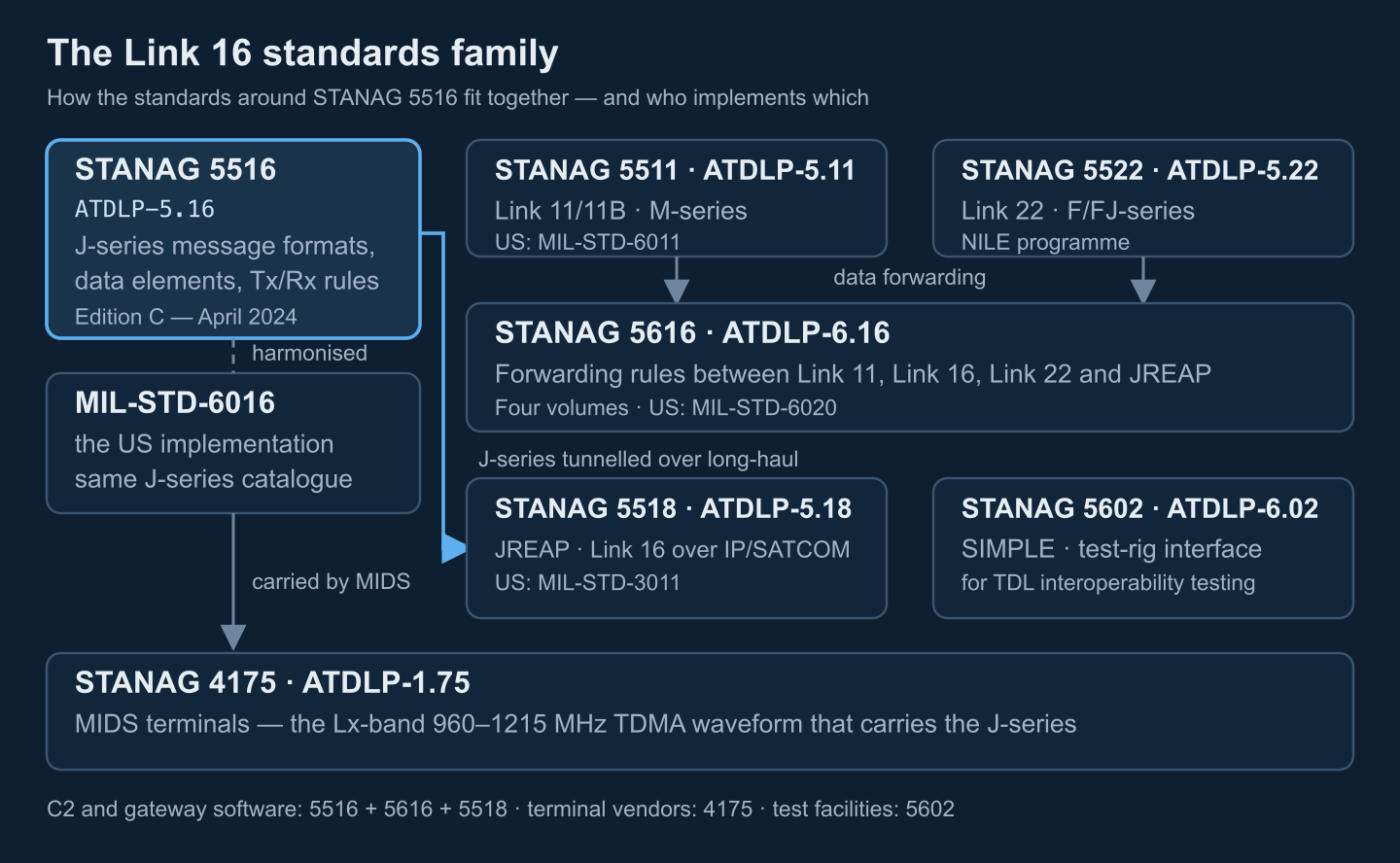
Link 16 never travels alone. A realistic interface control stack pulls in six to eight standards, and knowing which one owns which problem is half the scoping work. The map below shows how they relate and which product type implements which.
| Standard | Publication | What it defines | Latest public edition | US counterpart |
|---|---|---|---|---|
| STANAG 5501 | ATDLP-5.01 | Link 1 point-to-point exchange between air-defence centres | Ed 7 (2015) | — |
| STANAG 5511 | ATDLP-5.11 | Link 11/11B — M-series messages, HF/UHF netted link | Ed 10 (2019) | MIL-STD-6011 |
| STANAG 5516 | ATDLP-5.16 | Link 16 — J-series messages, data elements, exchange rules | Ed 9 (2024) | MIL-STD-6016 |
| STANAG 5518 | ATDLP-5.18 | JREAP — tactical data over SATCOM and IP long haul | Ed 6 (2026) | MIL-STD-3011 |
| STANAG 5522 | ATDLP-5.22 | Link 22 — F/FJ-series messages over HF/UHF (NILE) | Ed 7 (2024) | — |
| STANAG 5602 | ATDLP-6.02 | SIMPLE — interconnecting test rigs for TDL interoperability testing | Ed 4 | — |
| STANAG 5616 | ATDLP-6.16 | Data forwarding between Link 11, Link 16, Link 22 and JREAP | Ed 9 (2024) | MIL-STD-6020 |
| STANAG 4175 | ATDLP-1.75 | MIDS terminal technical characteristics — the 960–1215 MHz waveform | Ed 6 (2025) | — |
Editions as listed in public NATO standard catalogues in 2026 — always confirm the current edition through your national authority before freezing an interface.
How to read the map: STANAG 5516 defines the messages, while STANAG 4175 defines the MIDS terminal that transmits them — the split between the data layer and the radio is exactly the split between a C2 integration and a terminal programme (see the MIDS terminal guide). STANAG 5518 (JREAP) carries the same tactical data over IP and SATCOM when the network cannot reach — MIL-STD-3011 on the US side. STANAG 5616 defines the rules a forwarding unit follows when translating between Link 11, Link 16, Link 22 and JREAP — the standard behind a Link 16 to Link 22 gateway. STANAG 5602 (SIMPLE) interconnects test facilities for TDL interoperability testing, built on the IEEE DIS protocols. Link 22 itself is STANAG 5522 — start with what Link 22 is — and the trade-offs between the three NATO links are compared in Link 11 vs Link 16 vs Link 22.
How to get access to STANAG 5516 and MIL-STD-6016
NATO standards are distributed through nations, not to companies. The NATO Standardization Office database is the registry, but a vendor reaches the documents through its national defence ministry or national standards authority — typically under a programme contract, a national test programme, or an MoD sponsorship arrangement. The process is bureaucratic rather than secret: the catalogue metadata (titles, editions, promulgation dates, responsible teams) is public in NATO interoperability profile data and national standards catalogues; the full texts are distribution-controlled.
On the US side, MIL-STD-6016 goes through ASSIST under distribution statement C, with allied release requiring foreign disclosure authorization. Plan lead time in weeks, and note that some volumes and supplements — cryptographic management material, classified supplements — are more tightly held than the base standard. Engineering can start before the paperwork clears: public operational descriptions, training material and the DIS/HLA Link 16 simulation standard (SISO-STD-002) are enough to build a message-layer test harness and a conformance framework while the controlled documents are in transit.
Conformance and interoperability testing
Nobody self-certifies onto a tactical data link. Each nation runs a TDL technical authority that owns compliance: Canada's defence administration orders, for example, designate a joint TDL management section as the national technical authority for joint TDLs and require lab-based TDL interoperability testing to verify compliance with the standards before employment. In the United States, the Joint Interoperability Test Command (JITC) tests and certifies systems for military use.
Above the national layer, NATO's annual Coalition Warrior Interoperability eXploration, eXperimentation, eXamination and eXercise (CWIX) is where bilateral tests run against real partner stacks — an exercise that surfaces what conformance benches miss, not a certification body. SIMPLE (STANAG 5602) is the standard that wires test rigs together for exactly this class of testing. Preparation is an engineering programme of its own; the CWIX certification guide and our coalition test harness walkthrough cover the discipline. The short version: J-series message round-trip vectors belong in continuous integration from week one.
We implement J-series codecs and multi-link gateways against STANAG 5516/ATDLP-5.16, MIL-STD-6016 and the JREAP and data-forwarding standards, and we build the conformance test harnesses that national TDL authorities and CWIX test agents expect to see. If your programme needs a Link 16 interface, tell us which side of the terminal you sit on and we will scope it — plan your Link 16 conformance.
Implementation checklist for software teams
What to implement depends on which side of the terminal you sit.
If you are building C2 software or a gateway
- Obtain the current ATDLP-5.16 edition — and MIL-STD-6016 if US networks are in scope — through your sponsor before designing codecs, and record the exact edition and version in the interface control document.
- Implement the message subset your interface actually requires — typically surveillance, PPLI and information management first — with strict typing generated from the catalogue tables.
- Treat "no statement" field encodings as first-class values; collapsing them to zero is the classic first-field bug.
- Add JREAP (STANAG 5518 / MIL-STD-3011) for IP and SATCOM reach, and the STANAG 5616 forwarding rules if the product bridges links.
- Validate every inbound message against the catalogue and log structured rejects; buffer outbound traffic by priority instead of flooding the terminal.
- Build reference bit-pattern round-trip vectors and partner simulators into CI — the integration tactics are in part 2 of our interoperability implementation walkthrough.
If you are building a terminal or link-level component
- STANAG 4175 (MIDS terminal characteristics) dominates your scope — waveform, crypto, timing — while the message standard still defines what the host interface must carry.
- Time-slot allocation, network entry and relative navigation behaviour are certification items, not features.
- Plan for MIDS/JTIDS network design data exchange (ATDLP-7.03) and for integration testing against a reference test rig.
Either way, budget the conformance harness from the first sprint. It is the cheapest insurance in the programme: a failed certification round costs more than the harness ever will.
Link 16 conformance is an engineering problem, not a paperwork problem
We implement J-series codecs, JREAP and data-forwarding gateways against STANAG 5516/ATDLP-5.16 and MIL-STD-6016, and build the conformance harnesses national TDL authorities and CWIX test agents expect to see.
This guide was prepared by the Corvus Intelligence engineering team, which builds tactical data link gateways, J-series codecs and conformance test harnesses for coalition C2 programmes. About Corvus Intelligence →