Link 11 (TADIL A) is the 1950s-designed HF/UHF net in which a net control station polls each unit in turn: about 1.8 kbit/s of data and no jam resistance. Link 16 (TADIL J) is the jam-resistant L-band TDMA link for the air picture: 26.9–107.5 kbit/s per net, but line of sight only. Link 22 (NILE) replaces Link 11 with HF/UHF TDMA, automatic relay beyond the horizon and Link 16's data dictionary.
The practical verdict: put aircraft, air defense and weapons coordination on Link 16; hold a dispersed maritime force together beyond the horizon with Link 22; keep Link 11 only as long as a partner, platform or shore site still depends on it, and engineer the data forwarding that stitches the three into one picture. The rest of this page puts numbers behind that verdict.
Link 11 vs Link 16 vs Link 22 at a glance
The table compares the three links on the attributes that drive architecture decisions. Figures come from public NATO, NILE Project Management Office (PMO) and US joint-service documents. Data rates are what remains for tactical data after error-correction and synchronization overhead, unless stated otherwise.
| Attribute | Link 11 | Link 16 | Link 22 |
|---|---|---|---|
| US / NATO name | TADIL A (netted); the point-to-point Link 11B is TADIL B | TADIL J | NILE (NATO Improved Link Eleven) |
| Standards | STANAG 5511 (ATDLP-5.11), MIL-STD-6011 | STANAG 5516 (ATDLP-5.16), MIL-STD-6016 | STANAG 5522 (ATDLP-5.22) |
| Frequency bands | HF 2–30 MHz, UHF 225–400 MHz | L-band 960–1215 MHz, 51 hopping frequencies | HF 2–30 MHz, UHF 225–400 MHz |
| Channel access | Roll-call polling by a net control station (NCS); half duplex; broadcast modes | TDMA: 12 s frames of 1,536 slots (7.8125 ms each) pre-assigned to network participation groups (NPGs); no NCS | TDMA per NILE network, plus dynamic TDMA (DTDMA) and priority-injection slots; no NCS, no network time reference |
| Data rate | 1,364 or 2,250 bit/s line rate, i.e. 1,090 or 1,800 bit/s of data; Link 11B typically 1,200 bit/s | 26,880–107,520 bit/s per net depending on packing (28.8–115.2 kbit/s including parity); MIDS JTRS Enhanced Throughput exceeds 1 Mbit/s | 12,666 bit/s per UHF network; HF 1,493–4,053 bit/s, up to 9,600 bit/s with newer waveforms; up to 44,532 bit/s across 2 HF + 2 UHF networks |
| Range | HF ground wave to roughly 300 nm; UHF line of sight | Line of sight: about 300 nm, about 500 nm in extended-range mode; further only through relays, satellite or JREAP | HF beyond line of sight, optimized for about 300 nm (the NILE PMO quotes more than 1,000 nm); UHF line of sight; automatic relay |
| Jam resistance | None: fixed-frequency waveform | High: fast frequency hopping, spread spectrum, error correction and interleaving | Fixed-frequency networks can be jammed, but multiple networks and relay add resilience; frequency-hopping (EPM) media are much harder to jam |
| Security | Message encryption by an external crypto device (KG-40 family); no transmission security | Message security (MSEC) plus transmission security (TSEC) | Link-level COMSEC (LLC 7M) with integrity and time-based encryption; transmission security with hopping radios |
| Message format | M-series: two 30-bit frames, each 24 data bits + 6 error-correction bits | J-series: variable-length strings of 70-bit words | F-series: 1–8 Tactical Message Words of 72 bits; FJ messages carry J-series messages unmodified |
| Track numbers | 4 octal digits (0001–7777, about 4,000) | 19-bit, five characters: 00001–77777 and 0A000–ZZ777 | Same 19-bit scheme as Link 16 |
| Participants | Up to 62 unit addresses (octal 01–76) | 15-bit unit addresses; the slot budget is the practical limit | Up to 125 units and 8 networks per super network; one unit joins up to 4 networks |
| Typical platforms | Older surface ships, submarines, maritime patrol and early-warning aircraft, shore sites; Link 11B between ground air-defense and control sites | Fighters, AEW&C aircraft, air-defense ships, SAM fire units, ground C2 and air operations centers | Surface combatants, carriers, submarines, maritime aircraft and helicopters, shore sites |
| Terminal / equipment | Data Terminal Set (modem), crypto device, HF/UHF radios | JTIDS Class 2, MIDS-LVT, MIDS JTRS | NILE Communication Equipment: SNC software, LLC 7M crypto, signal processing controllers, HF/UHF radios; national data link processor (DLP) |
| Status | Legacy; being replaced by Link 22 (and by Link 16 in air roles); no alliance-wide switch-off date published | NATO's primary air-picture link; being modernized (crypto modernization, frequency remapping, Enhanced Throughput) | In operational service in several NILE and partner nations; fielding continues |
How each link shares the channel
The single biggest difference between the three links is how they decide who transmits next. Capacity, latency and survivability all follow from that choice.
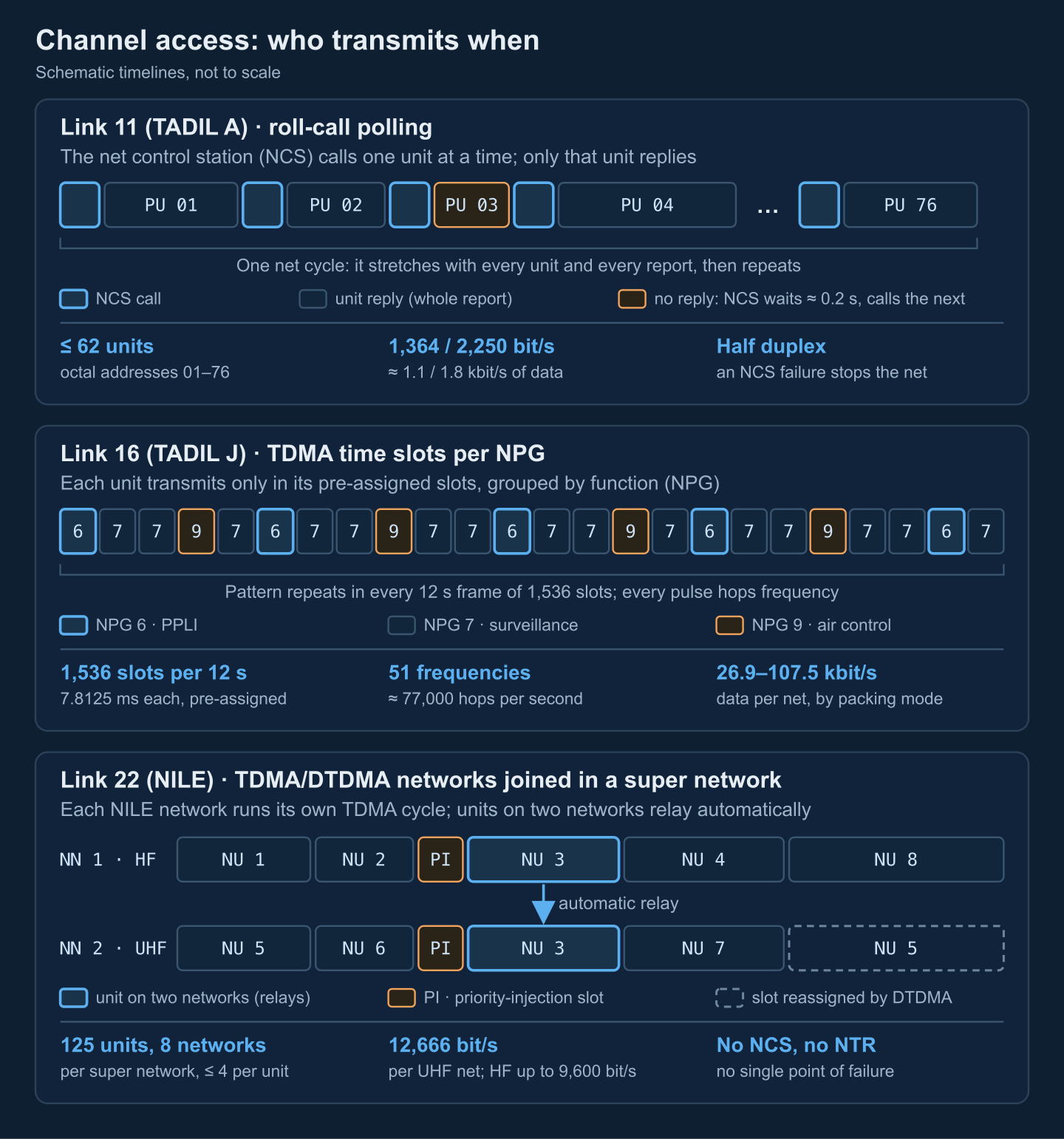
Link 11: roll-call polling. In normal operation one participating unit acts as the net control station. It transmits an interrogation addressed to one unit; that unit answers with its whole report while everyone else listens, and the NCS calls the next address. If a unit does not answer, the NCS waits about 0.2 seconds before moving on. The net cycle therefore stretches with every unit and every track, a unit with urgent information cannot jump the queue, and losing the NCS collapses the net. Broadcast and short-broadcast modes let a single unit transmit without being polled, but they do not change the one-talker-at-a-time design.
Link 16: fixed TDMA. Time is cut into 12-second frames of 1,536 slots of 7.8125 ms. The network design assigns blocks of slots to network participation groups, the functional circuits such as PPLI, surveillance, air control and voice, and to the units that transmit in them. Slots can be dedicated to one unit or shared under contention access, and several stacked nets can reuse the same slots on different hopping patterns. There is no controller: one unit acts as network time reference so others can synchronize and enter, but an established network keeps running without it. Slot budgeting is covered in our guide to Link 16 network design, NPGs and time slots.
Link 22: TDMA networks inside a super network. Each NILE network runs its own TDMA cycle (the network cycle structure) of timeslots allocated to units, plus optional priority-injection slots for urgent traffic. Planners size each unit's capacity need and access delay in the OPTASK LINK message, or the System Network Controller (SNC) computes the structure. Dynamic TDMA then lets a congested unit take spare capacity while the network runs. Up to eight networks, each on any HF or UHF media, form one super network of up to 125 units; a unit can sit on up to four networks at once, and the SNC relays a message automatically when an addressee is not directly reachable. There is no net control station and no network time reference. For the full system walkthrough, see what Link 22 is and how NILE works.
Link 11 vs Link 16: what changes in practice
Most platforms that left Link 11 went to Link 16 first, so this is the comparison engineers and planners meet most often. The jump is larger than the data-rate column suggests.
- Capacity and timeliness. A whole Link 11 net shares roughly 1.8 kbit/s, and a report is only as fresh as the poll cycle allows. Link 16 gives each net 26.9–107.5 kbit/s, stacks multiple nets, and gives every unit transmit opportunities that do not depend on how many other units are on the link.
- Precision. Link 11 reports positions on a grid relative to a data link reference point, which limits the usable area and rules out polar operations; Link 16 reports WGS-84 geodetic positions. Track quality runs 0–7 on Link 11 and 0–15 on Link 16, where the top value demands better than 50-foot accuracy.
- Functions. Beyond surveillance, Link 16 adds precise participant location and identification (PPLI) with relative navigation, air control, electronic warfare and weapons-coordination messages, and two secure voice channels at 2.4 or 16 kbit/s. The complete J-series message list shows the catalog.
- Survivability. Link 11 depends on its NCS; Link 16 is nodeless, because every slot is assigned in advance.
- Electronic warfare and security. Link 11 is a fixed-frequency waveform with message encryption only, easy to jam and, by the NILE program's own assessment, relatively easy to spoof. Link 16 hops across 51 frequencies at roughly 77,000 hops per second and encrypts both the message and the transmission.
- Where Link 11 still wins. HF ground wave carries Link 11 over the horizon, roughly 300 nm, with no relay aircraft, satellite or gateway. Link 16 needs airborne relays, satellite links or JREAP to go beyond line of sight, which is exactly the gap Link 22 was built to fill.
For the Link 16 basics (terminals, frequencies, packing), see what is Link 16; for host-side integration, our Link 16 software integration guide.
Where Link 22 fits
The NILE program stated Link 22's goals plainly: replace Link 11 and remove its limitations, and complement Link 16. It is primarily a maritime link for anti-surface and subsurface warfare, although it supports every environment. It keeps what made Link 11 useful, HF and UHF bands and reach beyond the horizon without satellites, and adopts what made Link 16 precise: J-family messages built on the same data dictionary, 15-bit unit addresses, 19-bit track numbers and WGS-84 positions. On top it adds the super network, automatic relay, DTDMA, and per-message priority and quality of service.
Against Link 16 the trade is reach versus throughput. Link 16 moves far more data per net and its fast-hopping waveform is the harder target for a jammer, but it stops at the radio horizon unless something relays it. Link 22 carries a fraction of the data per network, yet holds a dispersed force together over hundreds of miles and needs far less network planning. That is why NATO plans the two side by side rather than as rivals; the full head-to-head is in our Link 22 vs Link 16 deep dive.
Which link for which mission and platform
In real force packages the question is rarely which link, but which link carries what. A typical allocation looks like this:
| Mission or situation | Primary link | Why |
|---|---|---|
| Fighter, AEW&C and air-defense picture; weapons coordination | Link 16 | Throughput, jam resistance, PPLI and relative navigation, weapons-coordination messages |
| Naval task group dispersed beyond the UHF horizon, no satellite | Link 22 on HF | Beyond-line-of-sight reach and automatic relay without airborne relays |
| Submarines, maritime patrol aircraft and shore sites on the maritime picture | Link 22 (Link 11 on unconverted units) | HF reach, and the same data dictionary as the Link 16 air picture |
| Coalition partner equipped only with Link 11 | Link 11 through a forwarding unit | Keeps the partner in the picture until it converts |
| Ground air-defense and control centers | Link 16, extended by JREAP over IP, serial or satellite | Shares the air picture beyond terminal line of sight; Link 11B survives on legacy point-to-point circuits |
| Headquarters and C2 applications ashore | J-series over IP (JREAP-C) through a gateway | No radio needed; software consumes the same messages |
Platform constraints matter as much as missions. An aircraft that already carries a MIDS terminal gets Link 16 almost for free, while airborne Link 22 is still emerging: the NILE PMO's 2020 guide describes the LLC 7M crypto as built to airborne environmental standards but not yet formally certified for aircraft. Terminal choices and lead times are covered in our MIDS terminal guide.
Running all three: data forwarding, multi-link DLPs and gateways
A force that operates more than one link needs units that sit on two links at once and pass data between them. In NATO this is data forwarding, governed by STANAG 5616 (ATDLP-6.16) for Link 11/11B, Link 16 and Link 22, and the NILE program requires dual- and multi-link data link processors (DLPs) that act as forwarders to comply with it. US joint doctrine for the Link 11/Link 16 case spells out what a forwarder has to do:
- Correlate before forwarding. The forwarder compares tracks from the other link with its local tracks and reports only those it holds with higher track quality, so the same contact is not reported twice.
- Translate the participants. Link 11 units appear on Link 16 as indirect PPLIs (the US Navy uses NPG 14 for them), while Link 16 PPLIs appear on Link 11 as special-point friendlies.
- Expect fan-out. A single J-series message from the combat system can become as many as eight messages on Link 11 or Link 4A, and all Link 16 tracks reach Link 11 units during the forwarder's one poll, so filtering may be needed to avoid flooding older displays.
- Convert the grids. The forwarder translates between Link 16's geodetic reporting and the Link 11 grid, including its own position.
Link 16 and Link 22 are far easier to join than either is to Link 11. They share a data dictionary, and Link 22's FJ messages carry J-series messages without modification, so much of the work is re-framing rather than re-encoding. The NILE program's own guidance ranks the effort: a dual Link 16/Link 22 DLP is simpler than a dual Link 11/Link 22 DLP, and a full Link 11/16/22 multi-link DLP is the hardest to build. Our article on Link 16 to Link 22 gateway translation walks through the forwarding pipeline, and the pattern for off-platform consumers (JREAP, VMF, CoT) is in software gateways for tactical data link translation.
Running Link 11, Link 16 and Link 22 side by side? We build the software half of multi-link: M-, J- and F/FJ-series codecs for the message standards your program is authorized to use, track-number and track-quality mapping, forwarding and dual-reporting rules, and replay harnesses that test them against recorded traffic, plus the transition plan for retiring Link 11 without losing the picture. Plan a multi-link gateway with our engineers →
Migrating off Link 11
There is no alliance-wide Link 11 switch-off date in the public record. Replacement is national and gradual: NILE nations and partner navies add Link 22 as ships come up for upgrade, navies outside the program keep Link 11, and forwarding units bridge the gap. Spain, for example, fitted the amphibious ship Juan Carlos I with Link 22 in late 2022 and is including it in its S-80 submarines and the F-100 frigate mid-life upgrade, while the French carrier group exercised Link 22 with its aircraft during its 2024–25 Indo-Pacific deployment.
Three facts from the NILE program shape migration budgets. First, existing HF Link 11 radios already support Link 22's first six HF fixed-frequency waveforms, and some UHF Link 11 radios can be reused, so radios and antennas are often not the long pole. Second, the new items are the SNC software, the LLC 7M crypto (available only through US Foreign Military Sales), the signal processing controllers and, above all, the DLP, which the NILE PMO calls the most significant and costly part of a Link 22 implementation. Third, a dual Link 11/Link 22 DLP is harder than a dual Link 16/Link 22 one, which argues for retiring Link 11 functions early on platforms that already have Link 16. Our Link 11 migration guide lays out the phased plan.
What the differences mean for software
For the engineers writing the DLP or the gateway, the link-level differences turn into a short list of hard problems:
- Two track-number spaces. Link 11 numbers are four octal digits; Link 16 and Link 22 numbers are five characters in a 19-bit field. Numbers 00200–07777 on Link 16 correspond directly to Link 11's 0200–7777, so units reporting on both links normally use their Link 11 block as their Link 16 block. Anything above that range has no Link 11 equivalent and needs a persistent mapping table in the forwarder.
- Track quality and precision. Mapping 0–15 down to 0–7 is lossy, and a track forwarded up from Link 11 carries Link 11 precision no matter how many bits the J-series field offers. Keep provenance with every track and never let a forwarded track outrank a native one.
- Coordinates. Link 11's grid is relative to a data link reference point; Link 16 and Link 22 are geodetic. The conversion depends on the reference point and on the forwarder's own position, so both have to be right.
- Translation fidelity. M-series to J-series translation remaps fields with different resolutions and ranges, in both directions. Link 16 to Link 22 is much closer to lossless: FJ messages carry J-series content unchanged, and unique F messages are compact forms built from the same data elements, a few with no Link 16 counterpart. Generate translation tables from the standards rather than by hand, and test round trips.
- Timing. Track latency is set by the Link 11 poll cycle, the Link 16 slot schedule and the Link 22 network cycle plus relay hops, not by your code. Model it per link when you budget end-to-end latency.
- Test tooling. The NILE program supplies a reference system for testing the SNC, LLC and signal processing controllers, and the Multi-Link System Test and Training Tool (MLST3) exercises DLPs against Link 11, Link 16 and Link 22 message protocols.
The architecture that survives all of this is the one we recommend for any data link program: a canonical internal track model with versioned adapters per message standard, so adding Link 22 or retiring Link 11 changes an adapter, not the combat system. For the Link 16 standard itself, see STANAG 5516 and MIL-STD-6016 explained.
Bridging Link 11, Link 16 and Link 22?
We design and build multi-link gateway software: M-, J- and F-series translation, track-number mapping and forwarding rules, tested against recorded traffic. Tell us your links and platforms and we will scope the integration.
Prepared by the Corvus Intelligence engineering team, which builds tactical data link gateways, message codecs and multi-link C2 software; figures are taken from public NATO, NILE PMO and US joint-service documents. About Corvus Intelligence →