No single system will replace Link 16, and none has been designated to. As of 2026 the link is being modernized in place — new cryptography, remapped frequencies, higher throughput and software-defined MIDS-JTRS terminals — while a ring of complementary links grows around it. The question that actually matters for a program is not what replaces Link 16 but what shares the network with it.
That ring covers missions Link 16 was never built for: stealth-formation networking on fifth-generation fighters (MADL, IFDL), high-throughput IP mesh (TTNT), over-the-horizon maritime exchange (Link 22) and beyond-line-of-sight relay from low-Earth-orbit satellites.
Is Link 16 being replaced?
Two things inside the Link 16 stack are being replaced: the legacy cryptography, which the US National Security Agency mandated for modernization with the old algorithms originally set to expire at the end of 2021, and the fixed-function MIDS-LVT terminals that host the waveform. The waveform, the message catalog and the network model stay. Link 16 remains the only tactical data link common to effectively every NATO air force, most surface combatants and most ground-based air defense — a position no successor standard reproduces today.
One neighboring link is being retired: Link 11, the Cold-War-era roll-call link, whose formal successor is Link 22 — not Link 16. Confusion between those two successions is the single most common error in procurement documents we see: Link 22 replaces Link 11 at sea; nothing replaces Link 16 yet. The figure below maps the whole landscape — what is being replaced, what is being modernized, and what is being layered on top. For the waveform fundamentals (L-band, TDMA, time slots, J-series messages), start with our companion guide on what Link 16 is and how it works.
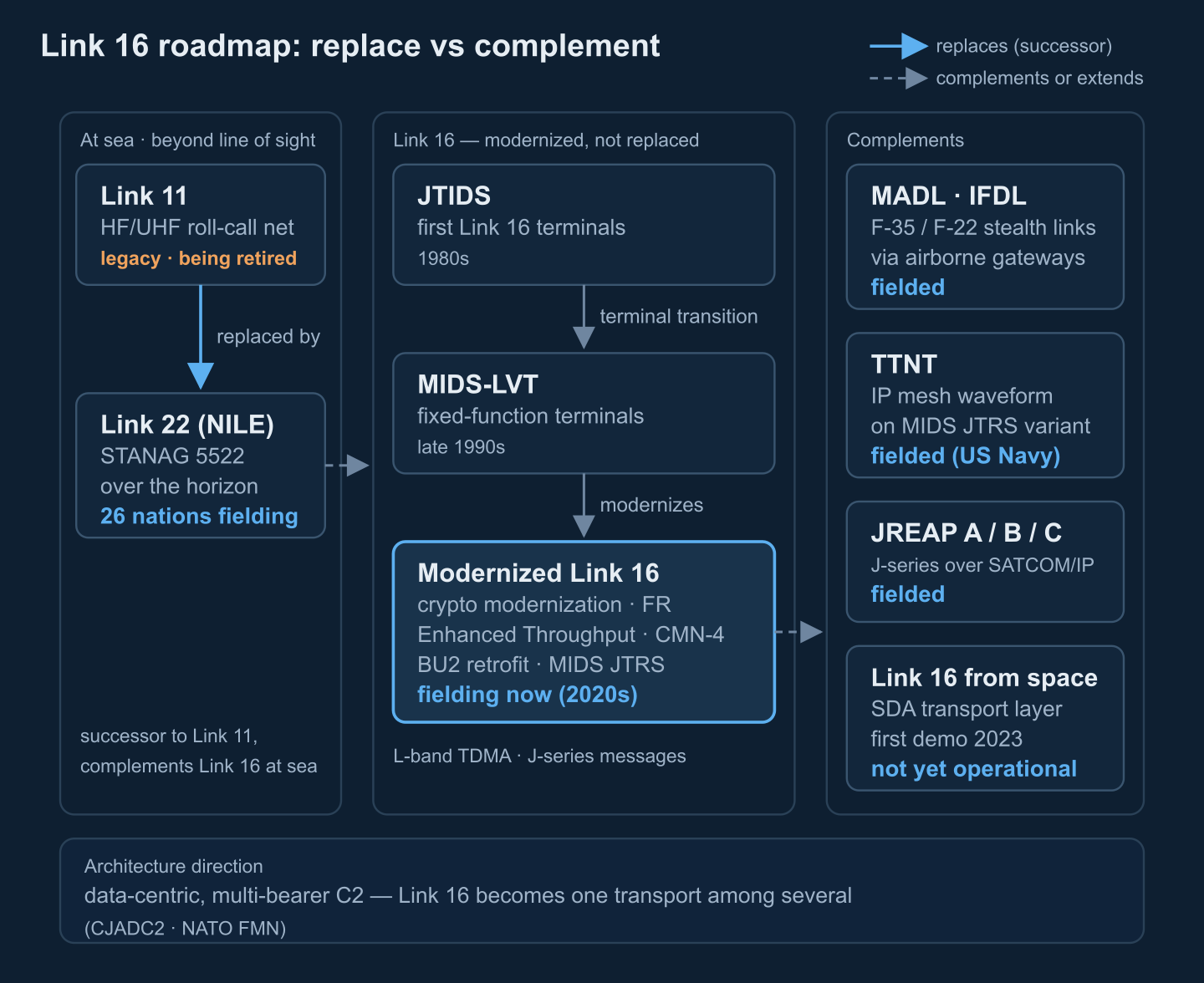
Link 16 modernization: Block Upgrade 2, crypto and CMN-4
The program most often misread as a replacement is Link 16 Block Upgrade 2 (BU2) — a terminal retrofit qualified in January 2020 that bundles three separate mandates into one modification:
- Crypto modernization (CM). NSA-directed replacement of the legacy Link 16 cryptographic algorithms with modern, reprogrammable security. Fielding slipped past the original end-of-2021 sunset — the US Air Force's portion was publicly flagged as behind schedule in 2022, prompting a congressional request for a GAO review — and un-modernized terminals are on a path to losing authorization to operate on modernized Link 16 networks.
- Frequency remapping (FR). Link 16 frequency-hops across the 960–1215 MHz band, which it shares with civil aviation systems. A National Telecommunications and Information Administration / Federal Aviation Administration mandate requires the hop pattern to be remapped so terminals can operate in constrained sub-bands — reducing interference with civil aeronautical systems and, as a practical side effect, making US training and testing far easier to authorize.
- Enhanced Throughput (ET). A new coding mode that raises the maximum network coded data rate from 115.2 kbps to over 1,100 kbps on terminals that support it — an order-of-magnitude jump aimed at imagery and situational-awareness file transfer, not at the track picture, which was never throughput-bound.
Alongside the retrofit, the Joint Requirements Oversight Council endorsed Concurrent Multi-Netting (CMN-4), Concurrent Contention Receive (CCR) and Enhanced Throughput as the Department of Defense baseline for all future Link 16 upgrades. CMN-4 lets one terminal receive on four net numbers in the same time slot — roughly four times the receive capacity of a legacy terminal — so a controller can monitor four networks or surveillance zones at once; CCR recovers usable updates when multiple same-net messages collide in a slot, the classic fighter-to-fighter case.
Note what all of this leaves untouched: the L-band TDMA waveform, the J-series message catalog and the governing standards, STANAG 5516 and MIL-STD-6016 (covered in detail in our STANAG 5516 guide and the J-series message list). BU2 is a capacity and security upgrade to the same link — which is precisely why it cannot be described as a replacement.
The terminal transition: MIDS-LVT to MIDS-JTRS
The hardware half of the story is the shift from MIDS-LVT, the fixed-function terminal family in service since the late 1990s, to MIDS-JTRS, a four-channel software-defined radio built to the Software Communications Architecture. The dedicated Link 16 channel is fully interoperable with LVT and small-form-factor terminals; three programmable channels host additional waveforms — most importantly TTNT in the Navy's MIDS JTRS TTNT variant, with an F-22 variant also in the family. Because JTRS keeps the MIDS-LVT form factor and host interfaces, platforms can upgrade without a redesign.
Fielding is broad and current: the US Defense Department is putting MIDS JTRS across F-15, F-16, F/A-18 and F-22 aircraft plus ship and command-and-control installations, and in December 2024 the Navy awarded Data Link Solutions — the BAE Systems / Collins Aerospace joint venture — an IDIQ contract worth up to $1 billion for continued production, retrofit and sustainment. The supplier base consolidated in January 2023 when L3Harris closed its roughly $2 billion acquisition of Viasat's tactical data links product line; European terminals come from the EuroMIDS consortium (France, Germany, Italy, Spain). The practical consequences for any program schedule — lead times, national crypto release, depot versus software upgrades — are covered in our MIDS terminal guide.
What will replace Link 16? The candidate map
Every serious answer to the replacement question is role-specific. The table below is the short version of this whole article: what each system actually replaces or complements, its status in late 2026, and who operates it.
| Capability | Replaces / complements | Status (late 2026) | Who uses it |
|---|---|---|---|
| Link 16 BU2 (CM, FR, ET) | Modernizes Link 16 in place | Fielding since 2020; production and retrofit ongoing | US and allied air, naval and ground forces |
| CMN-4 + CCR on MIDS-JTRS | Upgrades Link 16 receive capacity | Fielding; JROC-endorsed DoD baseline | US services and allies buying MIDS-JTRS |
| MIDS-JTRS terminal | Replaces MIDS-LVT terminals (not the waveform) | In production; F-15, F-16, F/A-18, F-22, ships, C2 | US plus allied operators |
| Link 22 (NILE, STANAG 5522) | Replaces Link 11 at sea; complements Link 16 | Fielding — 26 nations; first organic US ship operations in 2026 | NATO and partner navies |
| MADL (F-35) | Complements; stealth-formation sensor sharing | Fielded; reaches Link 16 via gateways | F-35 operators |
| IFDL (F-22) | Complements; Raptor flight-internal link | Fielded; F-22 gained Link 16 transmit in 2021–2022 | US Air Force |
| TTNT | Complements; high-throughput IP mesh | Fielded on US Navy aircraft; hosted in MIDS-JTRS | US Navy and Air Force |
| JREAP A / B / C | Extends Link 16 over SATCOM, serial and IP | Fielded for years | US and NATO |
| Link 16 from space (SDA transport layer) | Extends Link 16 beyond line of sight globally | In build; demos since 2023, utility targeted from 2027 | US (SDA); allied-airspace testing |
For a side-by-side of the three NATO links, see Link 11 vs Link 16 vs Link 22; the rest of this article covers each row in turn.
Link 22: the Link 11 replacement, not a Link 16 replacement
Link 22 — the NATO Improved Link Eleven (NILE) program, standardized in STANAG 5522 — is the one true succession story in this landscape, and it is about Link 11. It keeps Link 11's mission (beyond-line-of-sight exchange between dispersed naval forces over HF and UHF) but replaces the master-driven roll-call with dynamic TDMA and carries the F-series message set, deliberately designed to map onto Link 16's J-series so gateways can translate between the two without wholesale reformatting.
Adoption is real and measurable: the NILE project office reported Link 22 connecting ten platforms from seven nations at RIMPAC 2024, and 26 nations fielding the capability overall. In July 2026, during BALTOPS, the command ship USS Mount Whitney and the German frigate Hamburg became the first crews to bring up a Link 22 network organically — without contractor support — marking the link's shift from an integration novelty to an operational skill. None of that displaces Link 16: the two are designed to coexist, Link 16 for the line-of-sight air picture, Link 22 for over-the-horizon maritime coordination. The deeper comparison is in Link 22 vs Link 16, the Link 22 mechanics in what Link 22 is, and the migration playbook in getting off Link 11.
MADL and IFDL: fifth-generation links that need gateways
The fifth-generation fighters carry their own stealthy data links: MADL (Multifunction Advanced Data Link), a narrowband, directional, low-probability-of-intercept link that networks F-35s with each other, and IFDL (Intra-Flight Data Link), the F-22's flight-internal equivalent. These exist because an omnidirectional, high-power L-band transmission — Link 16 — is exactly what a low-observable aircraft tries to avoid emitting in a contested sky. The F-35 and F-22 can participate in Link 16 when emissions are acceptable, but their sensor fusion rides on the stealth links.
That split produced a decade of gateway engineering, and the pattern is now stable: translation nodes, not a common waveform. Northrop Grumman's Battlefield Airborne Communications Node (the E-11A aircraft) bridges dissimilar links in theater; the 2014 Jetpack demonstration translated MADL and IFDL into common Link 16 messages; the UK's 2017 Babel Fish III trial passed F-35B MADL data to a Link 16 Typhoon through the Freedom 550 software radio; and the 2020 gatewayONE experiment put a translating payload on an XQ-58A Valkyrie drone. Meanwhile the F-22 itself gained Link 16 transmit — receive-only for two decades — with fielding of the Raptor Agile Capability Release starting in late 2021 and the first fleet modifications completed in March 2022.
The lesson for architects: fifth-generation data will reach your fourth-generation force through a gateway you or someone else operates. Budget for it.
If your C2 system or sensor has to ride out this transition, that is exactly the software we build: waveform-agnostic multi-link gateways and C2 integrations that speak Link 16 today, add Link 22, TTNT or MADL-bridged feeds tomorrow, and survive terminal and crypto upgrades underneath. Plan a multi-link gateway with our engineering team →
TTNT and JREAP: the IP-native complements
Two IP-based systems do the work Link 16 was never designed for. TTNT (Tactical Targeting Network Technology, from Collins Aerospace) is an IP-based, self-forming and self-healing mesh waveform supporting more than 200 users with low latency and statistical-priority access — built for high-volume sensor and targeting data, multi-ship fusion and video, not for the compact J-series track picture. It is fielded across US Navy aviation — F/A-18 Block III Super Hornets, EA-18G Growlers and E-2D Advanced Hawkeyes share a TTNT common picture — and it rides the MIDS JTRS TTNT variant in the same chassis as Link 16.
JREAP (Joint Range Extension Application Protocol, MIL-STD-3011 and STANAG 5518 in NATO) is the older and quieter complement: it encapsulates Link 16 J-series messages so they can travel over non-Link-16 bearers. JREAP-A uses announced token passing over satellite communications, JREAP-B is a point-to-point serial mode, and JREAP-C — the workhorse — carries the traffic over IP networks using TCP or UDP, IPv4 or IPv6, including multicast. Every time a Link 16 picture reaches a headquarters across a continent, that is JREAP doing the carrying. Together with Link 22 these systems form the multi-bearer reality modern tactical networks actually run on.
Link 16 from space: the SDA transport layer
The most consequential development for Link 16's range is the Space Development Agency's Proliferated Warfighter Space Architecture. In November 2023, Tranche 0 satellites achieved the first-ever Link 16 network connection to and from space, transmitting tactical messages from low Earth orbit to ground radios in a Five Eyes partner nation; in August 2024 an SDA satellite performed the first Link 16 network entry from space to a US Navy aircraft carrier at sea.
The operational constellation — Tranche 1 — assigns 126 transport-layer satellites with Link 16 transmit/receive capability. Deployment is underway: 42 launched in September–October 2025, a third mission in July 2026 brought the on-orbit count to 63, and a fourth mission carrying 21 Northrop Grumman-built satellites slipped to later in October 2026 after a launch abort. The SDA targets initial warfighting capability for Tranche 1 in early 2027, with operational capability flowing to combatant commands from that year. Two caveats keep this honest: routine Link 16 broadcasting over the continental US still awaits FAA spectrum authorization — testing so far has run over allied airspace — and space-based Link 16 is a relay, not a new link: the terminals, messages and networks below it are the same ones this article has been describing.
CJADC2 and mesh networking: where the architecture is heading
Above all of this sits the architectural trend that explains the future of Link 16. The US Combined Joint All-Domain Command and Control (CJADC2) effort — which declared a minimum viable capability in February 2024 — and NATO's Federated Mission Networking approach both treat tactical data links as interchangeable transports under a data-centric fabric: applications subscribe to correlated track and sensor data, and the network picks the bearer, whether Link 16, Link 22, TTNT, JREAP-C over IP, or a satellite relay. That is why the Pentagon buys gateways and data fabrics while modernizing, rather than waiting for a single replacement waveform; for allied vendors the same logic applies through NATO's FMN standards, as we cover in what JADC2 means for European and allied vendors.
In that architecture Link 16's future role is specific and durable: the low-latency, jam-resistant, line-of-sight track exchange everyone already has — one bearer among several, stitched to the others by gateways. Nothing on any published roadmap displaces it from that role before the 2040s.
What this means for software and integration teams
For the engineers building C2 systems, sensors and effectors, the transition landscape reduces to three architectural commitments:
- Build a multi-link gateway, not a Link 16 client. Any system that speaks exactly one link is guaranteed to need translation the day it meets Link 22, VMF, MADL-derived feeds or a space relay. Gateway-grade concerns — decode, validate, map, re-encode, forward without duplication or loops — are well understood, and we treat them in depth in our tactical data link gateway software guide and the Link 16 / Link 22 translation walkthrough.
- Keep the data model independent of the waveform. Hold the tactical picture in a canonical internal model with versioned, hot-swappable protocol adapters for J-series, F-series, VMF and CoT. When BU2 adds an enhancement or a new bearer appears, you swap an adapter — not the combat system. This is the single design decision that makes the multi-link future cheap instead of ruinous.
- Get track number management right before anything else. Every network assigns track numbers in its own number space, reporting responsibility differs per net, and a forwarding node must rewrite both correctly or the picture fills with duplicates within seconds. A stable internal track identity mapped onto per-net numbers, plus strict loop suppression, is the difference between a gateway that fades into the architecture and one that becomes an incident report.
Link 16's replacement, whenever it eventually arrives, will be born into exactly this fabric. Systems designed against the fabric — multi-link, waveform-agnostic, track-disciplined — will absorb it the way they absorbed BU2: as one more adapter.
Plan the transition, not the funeral
We build waveform-agnostic multi-link gateways, J-series and F-series data layers, and C2 integrations that survive terminal, crypto and bearer changes — from Link 16 / Link 22 forwarding to space-relay-ready architectures.
This guide was prepared by Corvus Intelligence engineers who build tactical data link gateways and NATO-interoperable C2 software, and who track terminal, crypto and standards programs as part of that work. About Corvus Intelligence →