Delta, Ukraine's situational awareness and battle management system, exchanges data with five groups of systems: its own ecosystem modules (Monitor, Vezha, Target Hub, Mission Control, Element, UA DroneID); Ukrainian battlefield apps such as Kropyva and GIS Arta; intelligence and sensor feeds from drones, radars, satellite imagery, citizen chatbots and radio intercepts; allied systems over Link 16 and the NATO MIP specification; and the DOT-Chain Defence procurement stack. The table below lists every integration that is publicly reported.
Everything in this article comes from open sources: announcements by the Ukrainian Ministry of Defence, NATO ACT reporting on CWIX, and established defense media. Dates mark public announcements, not internal milestones, and nothing here describes non-public integration details. For the general integration principles, read our companion piece on Delta interoperability with C2 systems.
What Delta is and who develops it
Delta is the national situational awareness and battlefield management system of Ukraine's Security and Defence Forces. It is built to NATO standards, presents friendly and enemy forces on a shared digital map, and runs in an ordinary browser on laptops, tablets and phones. After a Cabinet of Ministers decision on 4 February 2023, its cloud components are hosted outside Ukraine to protect them from missile and cyber attacks.
Development began in 2015 with volunteer engineers of the Aerorozvidka NGO; the first prototype appeared in 2016 and the intellectual property was transferred to the Ministry of Defence in 2017. Since 2021 the team has been the Centre for Innovation and Development of Defence Technologies of the Ministry of Defence of Ukraine, working with the Ministry of Digital Transformation. Delta became broadly operational in August 2022, was adopted across the security and defense sector in August 2024, and on 6 August 2025 Defence Minister Denys Shmyhal signed an order deploying it at all levels of the Defence Forces. By December 2025 the Ministry reported more than 200,000 users and up to 10,000 drone video streams per day — official Ministry figures.
Delta sits inside a wider stack of Ukrainian battlefield software described in our overview of Ukraine's situational awareness ecosystem, and it is increasingly compared with Western command systems in C2 systems compared.
The list: systems that exchange data with Delta
The table consolidates every publicly reported data-exchange link, grouped by category. "Public since" is the month of the first official announcement or credible report.
| System | Type | What is exchanged | Public since |
|---|---|---|---|
| Delta ecosystem modules | |||
| Monitor | Digital map module | Common operational picture: layers, tracks, manual entries | Core module |
| Vezha | Video streaming module | Live video from UAVs and cameras to command posts | 12/2024 |
| Avengers | AI detection inside Vezha | Automatic detection of equipment in video (about 12,000 targets/week) | 2024 |
| Target Hub | Fire mission module | Creating, assigning and sharing targets | 02/2025 |
| Mission Control | Drone operations module | Mission records: drone type, route, result | 01/2026 |
| Element | Secure messenger | Encrypted coordination chat and information exchange | Current component |
| UA DroneID | Friendly drone identification | Friend-or-foe identification of Ukrainian drones | 04/2024 |
| Ukrainian battlefield apps | |||
| Kropyva | Artillery and reconnaissance app | Reconnaissance data and unit positions shared across command levels | 2022 |
| GIS Arta | Artillery fire coordination | Fires tasking within the shared ecosystem | Parallel use |
| Griselda | AI data-collection layer | Processed intelligence into Delta, Kropyva, GIS Arta and Bronya | 10/2023 |
| Intelligence and sensor inputs | |||
| eVorog | Citizen chatbot (Ministry of Digital Transformation) | Geolocated photos and videos of enemy forces | 03/2022 |
| STOP Russian War | Citizen chatbot (SBU) | Citizen reports of enemy movement | 2022 |
| Drones and cameras | UAV telemetry and video | Positions, tracks and live streams | 2022 |
| Radars, sensors, GPS trackers | Sensor feeds | Detections and tracks | 2022 |
| Satellite imagery providers | Imagery feeds | Satellite scenes and imagery layers | 2022 |
| Radio intercepts | SIGINT | Intercept-derived target locations | 2022 |
| NATO standards and coalition systems | |||
| Link 16 | NATO tactical data link | Track data, including from F-16 fighters | 07/2023 |
| MIP | C2 data-exchange specification | Battlespace information between command systems | Associate 07/2022 |
| Allied systems at CWIX | Coalition exercise testing | Full operational picture: air, land, sea, cyber, space, medical, logistics | 2019-2024 |
| TOPAZ (Poland) | Allied artillery C2 | Fires data and friendly-force positions | 07/2024 |
| Unmanned systems at REPMUS 24 | NATO exercise (Portugal) | Coordination of 50+ unmanned platforms | 09/2024 |
| Procurement and marketplace links | |||
| DOT-Chain Defence | Procurement system | Equipment orders and combat-effectiveness data | 08/2025 |
| Brave1 Market | Defense marketplace | Product catalog via Delta accounts; e-points redemption | 08/2025 |
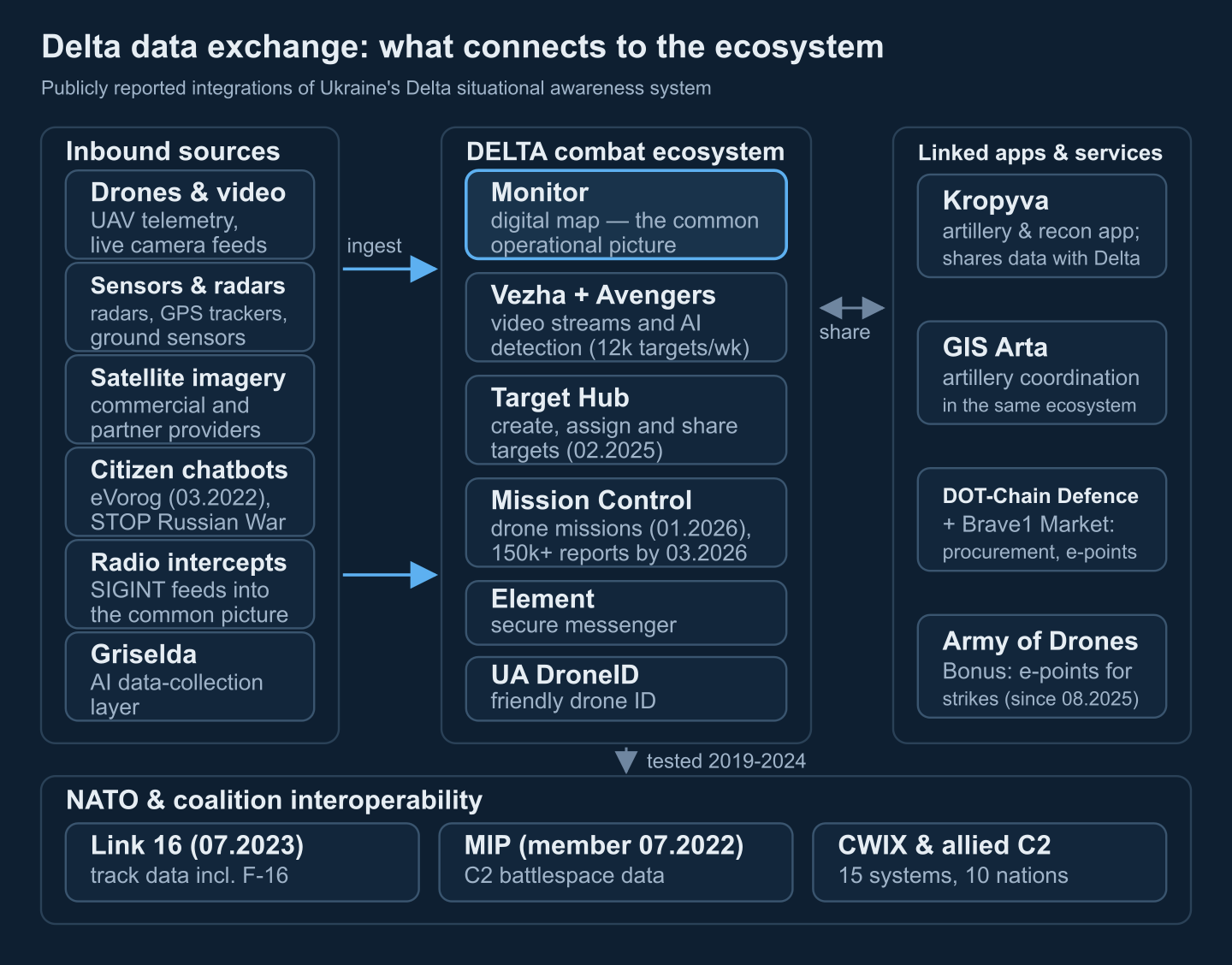
Inside the ecosystem: Monitor, Vezha, Target Hub, Mission Control
Delta is described by its developers as an ecosystem of modules behind a single login — "Google for the military", in the words of a Centre capability lead quoted by NATO ACT. The modules exchange data with each other and with outside systems.
Monitor is the digital map at the core: the common operational picture that other modules plug into. Vezha collects live video streams from UAVs and stationary cameras and passes them to command posts; the Ministry of Defence announced it as a combat module in December 2024, crediting the 411th "Yastruby" battalion and the Centre for Scaling Technological Solutions. Inside Vezha, the Avengers AI platform detects and classifies enemy vehicles in video. Ministry figures reported about 12,000 detected targets per week; at the London Defence Conference in May 2025 the Deputy Minister of Defence said Avengers detected roughly 70% of visible equipment at about 2.2 seconds per target — official claims that indicate the design intent of the loop.
Target Hub arrived on 12 February 2025: a module for creating, assigning and sharing targets on the Monitor map, so that units do not duplicate work on the same target. It was built by the Centre for Innovation and Development of Defense Technologies with the Centre for Scaling Technological Solutions and the 69th Separate Special Electronic Support Center, with combat units — including the 3rd Separate Assault Brigade and the 45th Separate Artillery Brigade — acting as expert consultants. Mission Control, launched in January 2026, is the unified digital system for drone operations in the Delta ecosystem: it records drone type, route, mission and result, had produced more than 150,000 digital mission reports by early March 2026, and is now operational across all corps and force groupings.
Two further components round out the picture. Element is the secure messenger through which units coordinate inside Delta. UA DroneID, under a memorandum signed on 10 April 2024 by the Ministry of Defence, the Ministry of Digital Transformation, the Aerorozvidka NGO and Cossack Labs, identifies friendly drones to reduce friendly-fire losses — Cossack Labs covers protocol architecture and cryptography, while Aerorozvidka and the Centre integrate manufacturers into Delta.
Kropyva, GIS Arta and Griselda: apps alongside Delta
Delta is the theater-level picture, but it is not the only Ukrainian battlefield software. Kropyva, the artillery and reconnaissance app, is one of the most-used combat systems in the Ukrainian military; a CSIS analysis from December 2024 describes Delta and Kropyva as complementary systems that share data across various levels of command, while noting they are not fully integrated. GIS Arta, the distributed artillery coordination system, operates in the same ecosystem.
The bridge between these tools is often a shared data layer rather than a direct point-to-point link. The clearest public example is Griselda, an AI data-collection and processing platform reported in October 2023 to be integrated into Delta and into the Bronya, Kropyva and GIS Arta applications. For how these apps divide the sensor-to-shooter loop, see the ecosystem overview above; for how Delta's model compares with the TAK ecosystem, read Delta vs ATAK.
Intelligence and sensor inputs: from satellites to chatbots
On the inbound side, the Ministry of Defence and the system's public documentation describe a deliberately wide set of sources: satellite imagery providers, radars, sensors and GPS trackers, radio intercepts, drones and cameras, reconnaissance units, and partner intelligence. The design assumption is that any verified source can become a feed into the common picture. A CSIS report notes that personnel contributed data on more than 600,000 enemy objects per month at the height of 2024.
The most unusual inbound links are citizen chatbots. On 12 March 2022 — just over two weeks after the full-scale invasion began — the Ministry of Digital Transformation's eVorog chatbot was connected to Delta, letting citizens submit geolocated photos and videos of Russian forces; the Ministry reported 433,000 users in its first nine months. The SBU's STOP Russian War chatbot was integrated later in 2022 on the same pattern. Aerorozvidka co-founder Yaroslav Honchar has said that new Western equipment supplied by allies integrates into Delta "almost automatically" because the system is built on NATO standards — a claim consistent with its CWIX record, though each integration still requires national testing.
NATO interoperability: Link 16, F-16 data, MIP and CWIX
Delta's coalition credentials are unusually well documented for a national system. At CWIX 2019 it was first confirmed as interoperable with NATO-standard systems. In July 2022 the development team became an associate member of the Multilateral Interoperability Programme (MIP), the framework that defines battlespace data exchange between allied C2 systems — the same family of specifications covered in our MIP4-IES ground standard guide.
In July 2023, after CWIX 2023, the Ministry of Digital Transformation announced that Delta had been successfully tested with 15 systems from 10 countries, including three NATO-developed systems, over four data-exchange protocols — the main one being Link 16, the NATO tactical data link that lets Delta receive data from F-16 fighters and other Western platforms (see what Link 16 is). At CWIX 2024 the team tested five standards across thirteen focus areas and demonstrated exchanging the full operational picture — air, land, maritime, cyber and space data, plus medical and logistics — with allied systems. In July 2024 the Ministry of Defence announced integration with Poland's TOPAZ artillery C2, including friendly-force position exchange, and in September 2024 the Ukrainian navy used Delta at the REPMUS 24 exercise in Portugal to coordinate more than fifty unmanned platforms. In February 2025 the Ministry demonstrated Delta, Avengers and UA DroneID at NATO TIDE Sprint in Helsinki under real combat conditions. Preparing for exercises of this kind is covered in our CWIX certification guide.
How the data exchange works in principle
The public record describes the "how" at the standards level rather than the interface level. Delta supports the MIP specification for battlespace data exchange between C2 systems, speaks Link 16 for tactical data links, and is web- and cloud-delivered with role-based access. Symbology and geodata follow NATO conventions — APP-6/MIL-STD-2525 symbols on WGS-84 coordinates — which is what makes allied integrations tractable; see APP-6 vs MIL-STD-2525 for the symbology decision.
Around Delta, the wider Ukrainian ecosystem also leans on the Cursor on Target family for edge situational awareness: TAK-family clients and drone telemetry pipelines commonly bridge into theater-level pictures via CoT, a pattern described in Cursor on Target explained and drone telemetry integration with TAK. What is deliberately not public is the per-interface detail — API specifications, endpoint architecture, and which internal service carries which feed — and this article does not speculate about them.
How a manufacturer or vendor gets connected
There is no public self-service API for Delta, and there is no published integration manual. The publicly described route runs through the Ukrainian Ministry of Defence: manufacturers engage with the Centre for Innovation and Development of Defence Technologies and the government-backed Brave1 defense-tech cluster, demonstrate the product, pass Ministry testing, and integrate under contract. Brave1 coordinates UAV manufacturers, robotics teams and software developers with operational units, and its events are where most integration conversations start. A product that already speaks the expected NATO formats shortens that path considerably — the same lesson that emerges from every coalition interoperability program.
Connecting a product to Delta or another C2 ecosystem? Corvus Intelligence builds integration adapters and data pipelines — NATO-standard formats such as Link 16, MIP-derived structures and ADatP-3, CoT/TAK bridging, and documented APIs — that prepare vendor systems for national testing. Discuss your C2 integration →
What to prepare before requesting integration
Whether the target is Delta or any comparable battle management system, the engineering preparation is the same, and it is worth doing before the first meeting:
- Standards support. Implement the expected message set natively: CoT for position reports, MIP-derived structures for ground-picture exchange, NFFI for friendly-force tracks, ADatP-3/ADatP-34 for message text formats, and STANAG 4586 where UAV control is involved.
- A written data contract. Pin down identifier persistence, timestamp semantics (observation vs generation vs transmission, UTC, millisecond resolution), coordinate conventions (WGS-84 with explicit MGRS handling) and vocabulary mapping tables with versioning.
- Classification handling. Every message needs first-class classification attributes whose labels survive every hop, per STANAG 4774/4778.
- Assume degraded networks. Queue-based, store-and-forward messaging with idempotent replay — not synchronous request/response — because tactical links are jammed, intermittent and slow.
- Security posture. Delta itself passed independent cybersecurity assessments in 2024 and early 2026 covering more than 160 requirements; anything connecting to it will be held to a comparable bar, so plan for audit, logging and secrets management from the start.
Where Corvus Intelligence can help
Corvus Intelligence is a Ukrainian defense software company and Brave1 member, but we are not an official Delta integration partner and we make no claim to privileged access. What we do build is the part vendors need anyway: integration adapters and data pipelines that speak NATO and TAK standards — Link 16 messaging, MIP-derived structures, ADatP-3, CoT — plus Corvus.Head, a battlefield intelligence dashboard that fuses multi-source feeds into one operational picture. That work stands on its own for any C2 integration program, in Ukraine or across NATO.
Connecting your system to a C2 ecosystem?
We build integration adapters and data pipelines — Link 16, MIP-derived formats, ADatP-3, CoT/TAK bridging and clean APIs — for vendors and programs connecting sensors and applications to command-and-control systems.
Prepared by Corvus Intelligence engineers who build NATO-standard data-exchange adapters and C2 dashboards, from official Ukrainian Ministry of Defence announcements, NATO ACT reporting and peer-reviewed analysis of the Delta programme. About Corvus Intelligence →