Military C2 systems divide into six practical categories — joint and coalition command systems, alliance air C2, land battle-management suites, fires C2, maritime combat-management systems, and tactical-edge / AI data platforms — and no fielded product covers them all. NATO’s ACCS runs alliance air operations; GCCS-J is the US joint system of record; SitaWare and JBC-P dominate land battle management; AFATDS coordinates US fires; the TAK ecosystem and Ukraine’s Delta own the tactical edge; Maven Smart System NATO and Anduril’s Lattice sit on top as data/AI layers. Choosing among them is an echelon-and-standards problem first and a product comparison second.
This page maps the landscape, compares the fielded systems side by side, and walks the decision path: how to choose, and when to build rather than buy. For the shared vocabulary and layered architecture behind every product below, see what a C2 system is and the complete guide to command and control systems.
The C2 software landscape: categories by echelon
C2 software is built for a specific echelon and function, and those two axes explain most of the market: a coalition air-operations centre does not buy what a mechanized brigade buys, and a squad cannot run a headquarters system. Six categories cover the fielded landscape:
- Joint and coalition C2 — the strategic and operational picture across domains: GCCS-J in the US, NATO’s command estate.
- Air C2 — planning, tasking and surveillance of air operations: NATO’s ACCS.
- Land battle-management systems (BMS) — corps HQ to dismounted soldier: SitaWare, JBC-P / MMC-S, France’s SICS, the UK’s Bowman/ComBAT.
- Fires C2 — fire-support planning and fire-mission processing: AFATDS, Ukraine’s Kropyva.
- Maritime C2 / combat-management systems — shipboard systems such as Aegis.
- Tactical-edge and data/AI platforms — the TAK ecosystem, Delta, Maven Smart System, Lattice.
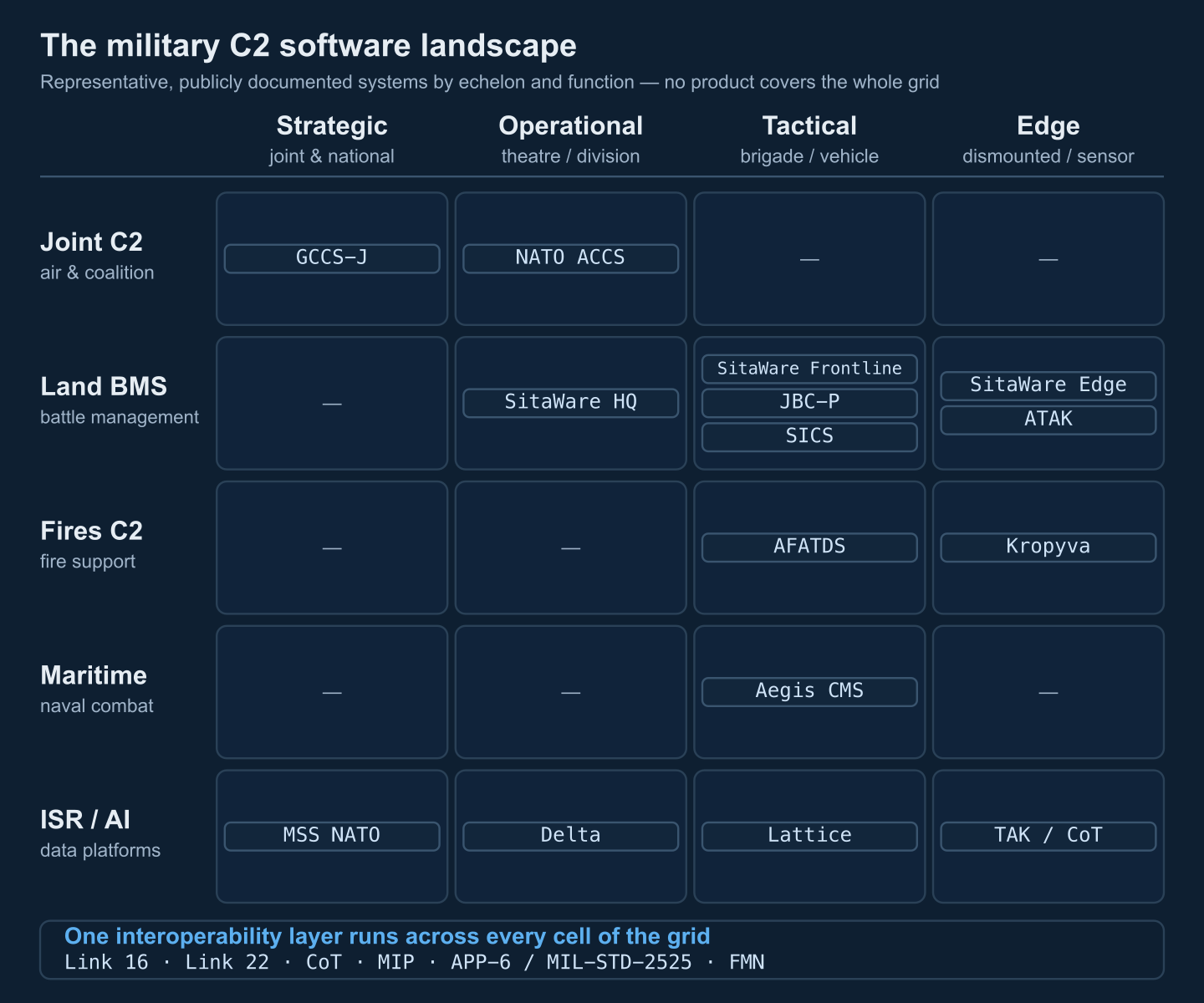
The empty cells are the message: no fielded product spans the matrix — the systems that come closest (GCCS-J, Delta, TAK) span echelons within one function, not functions within one echelon. The band along the bottom — Link 16, Link 22, CoT, MIP, APP-6/MIL-STD-2525, FMN — is why the grid works as one system-of-systems at all: standards, not products, connect a strategic command system to a squad’s tablet. What all of it exists to produce is the common operational picture; the products differ in whose picture, at which echelon, over which links.
C2 systems compared: the fielded systems in one table
Every row is a publicly documented, fielded system or family; facts come from the NATO, US-government, defence-media and vendor sources linked below, and standards listed are those the owner documents. Statuses change — ACCS roll-out, US NGC2 prototyping and the UK’s LE TacCIS were all mid-transition in late 2026.
| System / family | Domain & echelon | Owner / vendor | Deployment | Documented standards | Typical buyers |
|---|---|---|---|---|---|
| NATO ACCS | Air C2; operational–strategic | NATO (NCIA); core software ThalesRaytheonSystems | Fixed sites + deployable component | STANAG 5616 air-C2 messaging | NATO, member air forces |
| GCCS-J | Joint, all domains; strategic–operational | US DISA | Fixed HQs; web-enabled access | US joint messaging; JOPES → JPES | US combatant commands |
| SitaWare HQ / Frontline / Edge | Land BMS; HQ to dismounted | Systematic (Denmark) | HQ servers, vehicles, Android | MIP4, APP-11/ADatP-3, NFFI, USMTF, Link 16, APP-6 / MIL-STD-2525 | Armies of 30+ nations |
| JBC-P → MMC-S | Land BMS; mounted tactical | US Army (PEO C3T) | Vehicles on BFT satellite network | BFT reporting; TIGR integration | US Army brigades |
| SICS | Land BMS; battle group to vehicle | Eviden (Atos) for French DGA | Vehicle terminals, SCORPION fleet | SCORPION data model | French Army, Belgium |
| AFATDS | Fires C2; tactical | US Army; RTX (developer) | CP workstations, fire-direction cells | VMF K-series; ASCA fires interface | US Army, USMC |
| TAK (ATAK / WinTAK / TAK Server) | Edge SA; squad to TOC | US TAK Product Center (C5ISR) | Android / Windows; federated servers | Cursor on Target; APP-6 / MIL-STD-2525 | US forces, allies, agencies |
| Delta | SA / BMS; brigade to national | Ukraine MoD innovation centre | Cloud; browser and mobile clients | NATO-standard cyber cert; CWIX-2024-tested | Ukrainian Defense Forces |
| Aegis | Maritime; ship, task group | Lockheed Martin | Shipborne combat system | Link 16 / Link 22 | US and allied navies |
| Maven Smart System NATO | AI / data layer; strategic (ACO) | Palantir; acquired by NCIA | NATO operational environment | Vendor AI services (LLM / ML) | NATO ACO |
| Lattice | Sensor fusion; tactical edge | Anduril | Edge + cloud; REST / gRPC SDK | Vendor entity / task APIs | US DoD, allied pilots |
Buyers choose per echelon and function, then worry about how the pieces exchange data; the standards column is the real differentiator — MIP at land staff level, Link 16 in the air and maritime picture, CoT at the edge, FMN across coalition networks. The last two rows are layers over C2, not full C2 systems.
Joint and air C2: GCCS-J and NATO ACCS
ACCS. NATO’s Air Command and Control System, established in November 1999, gives the Alliance “a single, integrated air command and control system to manage NATO air operations in and out of the Euro-Atlantic area” (NATO) — planning, tasking, execution and surveillance in one system instead of national patches. The first site — Poggio Renatico, Italy, hosting a NATO air C2 centre and a deployable ACCS capability — went operational in 2015; fully deployed, the system is designed to interconnect more than 20 aircraft control centres across roughly ten million square kilometres of airspace. Core software came from the ACSI consortium (part of ThalesRaytheonSystems since 2000) under NCIA management, and national transitions are still in progress — an alliance-wide C2 programme is a multi-decade undertaking.
GCCS-J. The Global Command and Control System–Joint, run by DISA, has been the DoD’s joint C2 system of record since replacing the WWMCCS estate in 1996: situational awareness of friendly, enemy and neutral forces plus crisis-action planning for combatant commands, with service variants beneath the joint baseline. Modern releases added web-enabled access used by the US and partner nations, and the JOPES planning application is being succeeded by the Joint Planning and Execution System (JPES). It is the canonical strategic-C2 example: a classified, HQ-resident aggregation layer, not a fielded tactical product.
Land battle management: SitaWare, JBC-P, SICS, Bowman
SitaWare. Systematic’s SitaWare suite is the most widely fielded European BMS family: Headquarters for static and deployable command posts and seagoing platforms, Frontline for vehicle commanders, Edge for dismounted commanders on Android. Systematic publishes its interoperability stack — MIP, NFFI, USMTF and APP-11/ADatP-3 messaging, Link 16, OGC services, AIS and ADS-B (Systematic) — and states the suite is used by more than 30 nations; current releases align with MIP 4.4/4.5 (bridging back to 3.1), APP-11(E), FMN Spiral 4 and MIL-STD-2525D / APP-6(D). What MIP conformance actually obliges you to build is covered in our MIP4-IES walkthrough.
JBC-P and MMC-S. The US Army’s Joint Battle Command–Platform — successor of the FBCB2 / Blue Force Tracking lineage under PEO C3T — gives vehicles, aircraft and command posts friendly-force tracking and messaging, integrating TIGR patrol reporting, with Nett Warrior carrying the picture to dismounted soldiers. From late 2023 the Army began replacing JBC-P software with Mounted Mission Command–Software (MMC-S), a software-only upgrade reusing JBC-P hardware and the BFT satellite network; by 2025 official Army modernization writing treated MMC-S and TAK together as the tactical-COP layer.
SICS. France fielded one unified system instead of a long lineage: SICS (Système d’Information du Combat SCORPION), developed by Atos — the business is now Eviden — and delivered to the DGA in 2021, networks combined-arms battle groups and their vehicles (Griffon, Jaguar), replacing the earlier SIR/SIT family. Belgium joined the SCORPION ecosystem through the CAMO agreement.
Bowman and ComBAT. The UK is the cautionary tale. Bowman — General Dynamics UK’s tactical radio system carrying the ComBAT (Common Battlefield Application Toolset) BMS — reached BCIP 5.6 from 2019 across roughly 50,000 radios and 21,000 data terminals, with a 5.7 update in discussion. The replacement path is the lesson: MORPHEUS was paused in December 2023 after about £766 million, the wider LE TacCIS programme drew a red delivery-confidence rating in 2025, and the MoD keeps meeting requirements through Bowman updates. BMS replacement cycles run 15+ years — which is why modernizing a legacy C2 system is a discipline of its own.
Fires and maritime C2: AFATDS, Kropyva, Aegis
AFATDS. The Advanced Field Artillery Tactical Data System is the US fires C2: it automates planning, coordination, control and execution of fires across mortars, cannon and rocket artillery, close air support, naval gunfire, attack helicopters and electronic warfare. Fielded in 1996 and used by the US Army and Marine Corps (RTX holds the current sustainment contract), it receives digital calls for fire as VMF K-series messages and computes firing data against loaded coordination measures. Multinationally it connects to partner systems through ASCA — the Artillery Systems Cooperation Activities interface exercised at NATO Dynamic Front events.
Kropyva. At the opposite end of the budget spectrum, Ukraine’s Kropyva began as a 2014 volunteer project by Army SOS and was transferred to the Armed Forces with source code in 2018. An Android artillery-and-reconnaissance app, it computes firing solutions on the tablet from an observer’s grid and gun positions, plus mapping, messaging and UAV/radar integration; Ukrainian military media class it as a C2-type system and reported over ten thousand installations. It proves the fires-C2 function can be delivered at battalion scale by a small team in weeks — reshaping build-vs-buy expectations.
Maritime. Naval C2 centres on the combat-management system: Aegis — produced by Lockheed Martin and operated by the US Navy and allied fleets including Japan, Spain, Norway, South Korea and Australia — is the best known, integrating the ship’s sensors, weapons and command-and-decision functions into one console picture tied to the tactical data links (Link 16, Link 22 in newer fleets). It is the most hardware-coupled category here: the CMS is certified as part of the platform. The architecture is covered in our maritime C2 guide.
Tactical edge and data platforms: TAK, Delta, Maven, Lattice
The TAK ecosystem. The Tactical Assault Kit family — ATAK on Android, WinTAK, iTAK, TAK Server and WebTAK — originated at the US Air Force Research Laboratory in 2010 and is maintained by the Army C5ISR Center’s TAK Product Center, with the civilian ATAK-CIV variant publicly released in 2020. Its connective tissue is Cursor on Target, the XML schema that has become the de facto edge standard beyond TAK. TAK is the edge client layer of a C2 stack rather than a headquarters system — the distinction drawn in Delta vs ATAK.
Delta. Ukraine’s Delta, developed by the Ministry of Defence’s Centre for Innovation and Development of Defence Technologies, was adopted for the Defense Forces by government decision in February 2023. Browser-first and cloud-hosted, it fuses positions, sensor feeds, drone and camera streams, secure chat and reconnaissance planning into one map that scales from a brigade staff upward. In July 2024 it passed a NATO-standard cybersecurity certification — the first Ukrainian military system to do so — and at CWIX 2024 the Ukrainian team tested it against five interoperability standards across 13 focus areas, integrating live with Poland’s TOPAZ artillery system. What exchanges data with Delta today is tracked in Delta integrations.
Maven Smart System NATO. In March 2025 the NATO Communications and Information Agency finalized the acquisition of Palantir’s Maven Smart System NATO for Allied Command Operations — about six months from requirement to acquisition, among the fastest in NATO’s history (NCIA). NATO describes it as a common, data-enabled warfighting capability delivering AI applications “from large language models to generative and machine learning” for intelligence fusion and targeting, battlespace awareness and planning, and accelerated decision-making. Note what it is not: a replacement for ACCS or national C2 — it is a data and AI layer over them.
Lattice and NGC2. Anduril documents Lattice as an open, extensible platform whose common operational picture is built from entities — assets, tracks and geo-entities — taskable through REST and gRPC APIs, with a public SDK. The US Army’s Next Generation Command and Control (NGC2) effort made the model programmatic: in July 2025 it awarded a $99.6 million prototype agreement to an Anduril-led team (including Palantir and Microsoft) for an integrated C2 suite on a common data layer for the 4th Infantry Division, then a $26 million agreement to a Lockheed Martin team for the 25th Infantry Division’s data layer. NGC2’s four-layer stack — transport, infrastructure, data, applications — is a data-centric re-architecture, not a product refresh; the alliance-side consequences are covered in what JADC2 means for European vendors.
How to choose a C2 system: six filters, in order
- Requirements and echelon first. Locate yourself on the grid — function, echelon, users. Most failed procurements buy a product built for a different cell.
- The interoperability set. Decide the standards you must speak before looking at products: MIP for ground staff exchange, Link 16 for the air picture, CoT at the edge, APP-6 / MIL-STD-2525 symbology (APP-6(E) is current), FMN profiles for coalition networking. Each is months of engineering.
- Deployment and DDIL. Cloud, on-premises, air-gapped, vehicle and dismounted edge are different products in practice. Demand store-and-forward behaviour, offline clients and demonstrated operation on degraded links — not a roadmap line.
- Security and accreditation. Classification labelling, RBAC and releasability enforcement at the data-object level, plus an audit trail — and a realistic view of your accreditation timeline, which often dominates the schedule.
- Cost and sovereignty. Model 20-year total cost of ownership: licences, integration, infrastructure, training, sustainment. Sovereignty — where code, data and hosting live, and which export regime attaches — increasingly decides the shortlist before price does.
- Vendor lock-in. Who owns your data model, and can you export it? Open SDKs, published schemas and portable formats let you replace a component in year ten, not the system.
For the procurement-grade version, the 12 criteria for evaluating military C2 software turn each filter into demo tests and red flags.
Build, buy or integrate — and when custom C2 wins
The honest answer is rarely pure. Three strategies dominate, set by your position on the grid and your interoperability obligations:
| Strategy | Choose it when | Watch out for | Examples |
|---|---|---|---|
| Buy fielded | Requirements match NATO-standard workflows; time-to-field dominates | Doctrine fit; per-seat licence growth; export-control conditions | A SitaWare-class BMS; TAK Server at the edge |
| Configure + integrate | Mixed estate; coalition obligations; sensors arriving faster than roadmaps | Integration engineering is the program — gateways, conformance, releasability | A bought core with a custom COP and link gateways |
| Build custom | Sovereign requirements; unique sensor mix; wartime iteration speed | 20-year sustainment, accreditation, staffing | Ukraine’s Delta and Kropyva lineage; national COP programs |
Custom development makes sense in four recurring cases. Sovereign control — the data model, hosting and roadmap must stay national, as France’s SICS and Ukraine’s Delta illustrate. Non-standard sensors — the picture depends on UAV, EW and SIGINT feeds that fielded systems do not natively ingest. Coalition bridging — someone must translate between your national system and NATO exercise networks. And rapid wartime iteration — Ukraine showed a small team shipping weekly against real feedback outperforms a years-long requirements cycle, with standards alignment added retroactively. The full pattern is described in our analysis of Ukraine’s battlefield situational-awareness ecosystem.
Comparing systems is the easy half. Making your chosen stack actually exchange tracks with drones, radars, EW/SIGINT feeds and allied C2 is where programs stall. We build custom C2 dashboards and COPs, and integrate fielded systems — TAK, Delta, SitaWare-class BMS — with sensor feeds and NATO data links. Tell us which cells of the grid your program must fill and we will scope the integration.
Reference architecture of a modern C2 stack
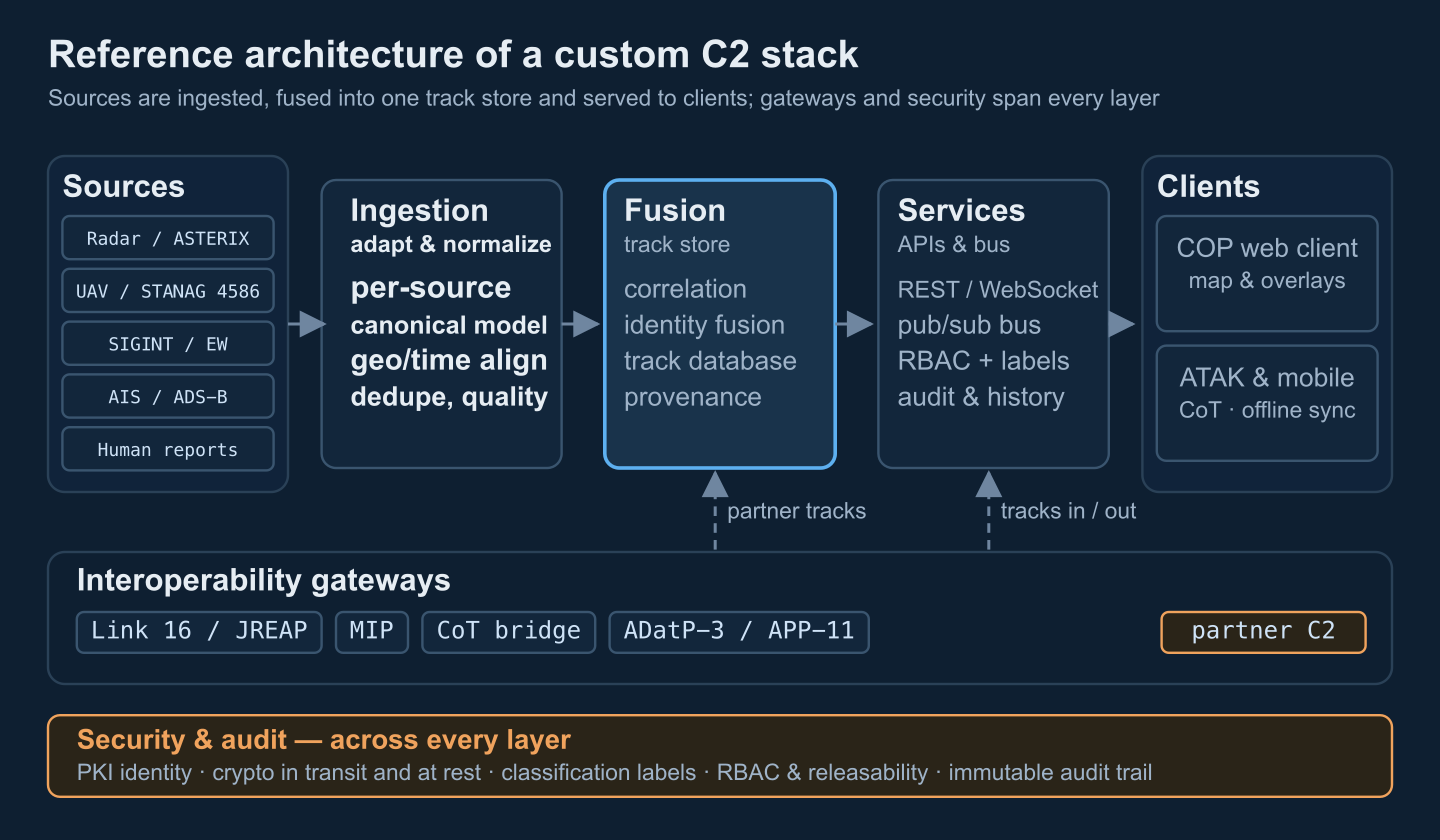
Whether you buy, integrate or build, the target architecture looks the same, because the constraints are. Sources arrive in native protocols — radar as ASTERIX, UAV feeds per STANAG 4586, SIGINT and EW reports, AIS and ADS-B, human reporting — and ingestion normalizes them into one canonical model before anything else sees them. The fusion core correlates and de-duplicates those observations into an authoritative track store carrying identity, confidence and provenance; it must be singular — two track stores mean two pictures. A services layer exposes it — REST and WebSocket for staff clients, a pub/sub bus for high-rate feeds — enforcing RBAC, classification labels and audit on every call. Clients are a web COP for the command post and mobile / TAK clients at the edge, both with offline caches. Interoperability gateways — Link 16 / JREAP, MIP, a CoT bridge, ADatP-3 / APP-11 messaging — move tracks in and out to partner systems, and security and audit span every layer.
Three rules keep it honest: never let a sensor-specific format past the ingestion boundary; keep exactly one authoritative track store; treat standards as edges, not the core — the canonical model is yours, the translations are peripherals. This is the stack we build; the foundations are laid out in building a C2 system from scratch, part 1.
Filling a cell in the C2 grid?
We build custom C2 dashboards and common operational pictures, and integrate fielded C2 systems — TAK, Delta, SitaWare-class BMS — with drones, radars, EW/SIGINT feeds and NATO data links.
Prepared by the Corvus Intelligence engineering team, which builds custom C2 dashboards, TAK/CoT integrations and tactical data-link gateways for defense programs; every system fact on this page is taken from the cited NATO, US government, defence-media and vendor sources. About Corvus Intelligence →